Tuesday, July 1, 2014

Barrister, Banister, Baluster, Bermuda-A Spelling Bee Soliliquy

OK, admittedly, I have a word problem.  It's not near as bad as some other proclivities I have entertained myself with in the past, and it really isn't harmful to my health.  My mind maybe, but not my physical well being.  Well, up until the point I annoy someone enough that they hit me upside the head with a plastic pink flamingo.  Or a 2x4.  Whichever was handiest I suppose.

A barrister, I see, is an attorney, primarily with chops in the Grand Marquee.  That would be the Courtroom, you see.  There are attorneys who are very knowledgeable, but they lack that certain chutzpah and vernacular that allows them to roam with the greatest of ease through the parables and pitfalls of the courtroom.  Their strength is in legal knowledge, not courtroom theatrics.  In another life, I knew both.  More intimately than I would have liked, probably.

In this life, I still know a few.  Fortunately I have not had to utilize their expertise, but good to know they are there, just in case.  If anyone out there in Northern California has suffered a personal injury and needs a true barrister, let me know.  He is an old, dear friend and does not advertise his services.  All his clients are from word of mouth.  His prowess is legend.  Denny Crane has nothing on this litigating lion.

I also know someone fairly high up in the County Public Defenders office.  His criminal defense jabberwocky is also legendary and he definitely does not fit the the typical inept public defender mold.  You could pay a criminal defense lawyer thousands of dollars and not come anywhere close to his legal acumen.  The riff raff he defends on a daily basis have no idea they're in the presence of Perry Mason's mentor.

While I'm on a roll, if you're in need of an estate planning attorney you can't go wrong with Lenhart Legal Services.  Gabriel is a fine young man who is quite knowledgeable in his chosen legal field.  If you are anywhere near my age and you don't have a will or estate plan, YOU NEED TO DO THIS, especially if you have anything to pass on to heirs.  Otherwise the government's gonna get half.  Don't they get enough already? If you lost all your money in the 2008 crash, don't bother.  But if you've got five figures and more in assets and don't have a will then you need to call Lenhart Legal Services NOW!!!

OK, now that I've plugged my buddies and have a small credit just in case, let's move on to Bermuda.

Ah, Bermuda.  My first thought is the island with warm turquoise water and white sandy beaches.  Resort wear everywhere and tropical rum drinks.  But then my mind tends to wander a bit.  Words.  What about the Bermuda Triangle?  Bermuda shorts?  Bermuda onions?  Bermuda grass?   It's never ending.  What's wrong with me?

Bermuda, the island, was first settled in 1609 by shipwrecked English colonists headed for Virginia.  Self-governing since 1620, Bermuda is the oldest and most populous of the British overseas territories. Vacationing to the island to escape North American winters first developed in Victorian times. Tourism continues to be important to the island's economy, although international business has overtaken it in recent years. Bermuda has also developed into a highly successful offshore financial center. A referendum on independence from the UK was soundly defeated in 1995.

I got that little tidbit off the CIA website.  They've got lots information on just about every country and island there is out there.  They've probably got lots of information on just about every person there is out there too, especially you.  And me.  Probably me more than you, but, you know, hopefully you more than me.      

Bermuda, the triangle, has never really been  figured out or discovered.  It's just sorta out there.  Or not.  If people knew what it was all about then they would have probably figured out where all them things went to.   It's not even noted on the CIA website, and they have information on everybody, every place and everything for crying out loud.


Bermuda, the shorts, are a clothing item named for the place where they first became a popular fashion. They are a style of trouser shorts that are cut to just above the knee. Being short pants, they are considered semi-casual and are usually neatly tailored with cleanly cut lines and a clean hem. 

I did not get that little tidbit from the CIA website.  If they have become concerned about short styles then I think we've taken the term "fashion police" to a whole new level.  The next thing we'll know is they'll be locking up people like Richard Simmons and Lady Gaga at Guantanamo.   

Bermuda, the onion, can be, apparently, just about any gosh darn color it wants to be according to the thousands of so called knowledgeable sites out there.  What is distinguishing though is that it is round and flat.  And sweetish.  NOT Swedish.  Otherwise it'd be called a Swedish Onion.

Bermuda, the grass, apparently can be a troublesome weed or an excellent lawn grass. I suppose it depends on whether you water it or not.  Mow.  Fertilize.  Stuff like that. 

Now let's mosey on to Banister, which is essentially a handrail with supporting posts.  It can run along a porch or down a staircase.  It can also be called a Balustrade.  Which brings us to our next conundrum, Baluster, which is a decorative type of spindle or stair stick that sits underneath the handrail and in between the supporting posts.

And now you know. 

So one day not so long ago while I was enjoying the sunset view, I happened to look down and noticed a little wear and tear on the banister balusters.  The entire balustrade was looking war torn and weary.   Not only was paint flaking, but cracks were starting to appear in the wood.  Dry rot was also beginning to show where  many of the balusters met the lower rail.

See, aren't we glad we had our earlier lesson?  Otherwise you would have had no idea of what I was talking about, and neither would I more than likely.   Whatzit and thingy work just fine for me.

Our front covered porch, of which I prefer to refer to as Veranda, faces West.  It is wide open to the setting sun, and also wide open to those wayfaring westerlies that blow on nigh from time to time.  Even with a two foot overhang, the entire balustrade gets wet quite often.  I mean, rain certainly doesn't always fall vertically.  And every once in a while we get a storm that soaks the entire porch and really belligerently blusters over our balustrade.  Yeah, real fast-ten times.

The overall exterior paint job, while entirely the wrong shade of yellow, is actually in fairly decent shape.  And Lord knows, there's enough stuff to do around here without entertaining the thought of an entire exterior paint job.  We did the entire interior before we moved in, the outer can wait.  Except for the balustrade.  I'd much rather scrape, sand, caulk and paint than replace.  Anyday.

Dammit.

So that's what I've been doing these last couple weeks.  I've been scraping, sanding, caulking and painting. 

Have you bought a gallon of good exterior paint lately?  Holy Schmoley.  Almost $50 for a gallon of nice, white semi-gloss.  I mean, what are they putting in paint these days?  Unicorn urine?


So I've been doing that as well as bucking firewood.  Yeah, this 'ol dude carried down off the hill a couple cords of logs and sticks that I cut down in My Gym...  That got stacked and now I'm working through it, bucking it down to 18-20" lengths.  I typically switch days, just like the gym.  One day is back and knuckles, the next forehead and chin.  Hey, what can I say?  Somehow it all works for me.  


We recently had our first harvest of peaches off a 2nd year tree, which you can read all about at Eat a Peach.  More recently we just harvested a bounty of apricots off a more established grafted tree.  The first 3 years we were here both sides of the tree blossomed abundantly.  And then snow lightly fell upon all the dainty little blossoms and froze their naked little hearts.  We never saw any fruit.  I plumb forgot what kind of tree(s) it was.

This year they both blossomed abundantly again, and they were alive with happy little buzzing bees.  I was hopeful they would go to fruition so that not only would we get some fruit, but I could remember what the heck kind of tree(s) it is.

I did meet with the previous owner before we bought the place, but he went over about six thousand things in the forty minutes we spent together.  So pardon me if I forgot a few of them.

At any rate, look at this sweet little bucket we got from the apricot side of branch town:
That was the first one.  We pulled another about twice that size.  They're pitted and in the freezer right now.  I'm thinking Apricot Pie ala mode for the 4th.  Mmmmmm.

And just so's you get an idea of what I'm talking about as far as the graft is concerned, here's what the trunk looks like.  By the way, that's one of the outdoor watering holes for the animals, not some weird, whacked out watering scheme for the tree.
To the left is the apricot side of the equation, whose top looks like this:
To the right is the plum, whose top looks like this:
I've pulled about 6 plums so far this year, but in the next week or so it looks like we'll be picking about 60 more.

And the apple tree, well, the apple tree is off the hook.  The first year we were here there were a few apples that we harvested.  But then the next two years I worked on getting the tree down to a manageable size and pruned the heck out of it, limiting the amount of apples to just about zero.

But this last year I barely trimmed it, and we have  a couple hundred on the dang thing.  And that's after I thinned the herd, dropping off at least 50-60.  This year we'll be making some applesauce and apple pie to be sure, and maybe, just maybe, we'll be able to figure out what kind of apple tree she be.

Have a safe and happy 4th!


Friday, June 13, 2014

Eat a Peach

Besides being one of my absolutely most favorite albums by one of my absolutely most favorite bands and which album contains one my absolutely most favorite songs, which I dedicate here to my lovely wife, because, well, she is my Blue Sky, besides all that, the peach is one of my absolutely most favorite fruits.

It would only stand to reason then that given ample room to grow a few fruit trees, a peach tree just might be one of them.  We currently only have four trees in our fledgling orchard, which is on hold for the moment until we get a little more sustained water from the sky, but one of them just so happens to be a peach, in more ways than one.

Three of the trees were purchased in late summer of 2012 and wintered over in 5 gallon pots.  They were finally put in the ground with a fourth tree after extensive clearing in February of 2013.

This spring, a year later, our Santa Rosa plum tree is bare and there is but one Honey Crisp on the apple tree.  That's sort of what I expected from fruit trees in their second year in the ground. 

On the other hand, the Perez white nectarine, which is actually a year older than the other 3 trees, has a bounty upon it.  We were blessed with 3 nectarines last year, this year looks like it'll be about 30.

And the peach tree, only in it's second year, well, the peach tree looked a lot like this:

And the first bucket off that tree looked a lot like this:
A second bucket with a good dozen was picked a few days ago.  And there's about 15 more on the tree.  Hot damn!  Fresh, home grown organic peaches.  Love them peaches.  Which reminds me of another song, since  peaches really are quite lovable.

As a dessert ingredient, peaches are famous and quite fabulous.  Peach Cobbler, Peach Melba, Peach Crisp, Peach Flambe, Peach Puddin, Peach Pie!  To name a few.

Mmmmm, peaches.

Here's a Peach Cobbler tip: Double the sugar in the dough.
Here's a Peach Melba tip: DON'T ever name a child this.  Maybe a parrot, or a llama, or maybe your toast.  But definitely NOT a child.
Here's a Peach Crisp tip: Double the topping.
Here's a Peach Flambe tip: Use decent brandy.
Here's a Peach Puddin tip: There is no such thing.  I dare you to try.
Here's a Peach Pie tip: Add 1 T sugar, 1 t Cinnamon, a pinch of Nutmeg and 1/2 T Apple Cider Vinegar to your crust.  (Add the vinegar when you're incorporating the ice water.)  Besides holding in the actual pie body, I think a pie crust should also be a flavor festival and compliment the main pie ingredients.

I am really quite surprised and amazed at our peach bounty this year.  I mean, the tree is only in its second year.  I definitely babied them last summer, maybe it all paid off.  They were watered extensively, and I also put wood chips to a depth of about 4 inches in a radius of about 5 feet all around the trees.  Besides breaking down and adding nourishment to the soil, wood chips also add a nice FAT layer between the soil and the sun.  That definitely helps the surrounding ground retain moisture, especially helpful in a drought year.

Since I have a little worm bin and manufacture worms and worm compost on a small time homestead type scale, I have also added some compost AND a few worms around the base of all four trees.  One of our neighbors, a very knowledgeable organic gardener, swears that earth worms go together with wood chips like potato chips do with Escargot.

Or something like that.

I have also added about a half cup of chicken manure (each year) around the base of each tree.  That naturally recurring phenomenon around here is packed with nitrogen, among many other beneficial nutrients.  It can be "hot" right out the gate, so I have a naturally recurring aging poop pile by the naturally recurring compost bin.  Yeah, a lot of things seem to naturally recur around here.

This year I will not be watering the fruit trees near as much as I did last because of the drought.  As babies, they easily averaged about 20-25 gallons a week.  

In doing some drought research, I found that trees should get at least 5 gallons per week per inch of trunk diameter.  Since my trees are yet youngsters with trunk diameters between 1 and 2 inches, they'll need between 5 to 10 gallons per week.  That's easy.

But how much water do established fruit trees need?  An old chum who owns a fruit tree nursery in Arizona sez,

" Your watering is real simple; get water to the "Root Zone"!  

Sounds simple right?

Well, it is once you know where that root zone is.  Most people know to water near the drip line of a tree or bush, but with fruit trees it's different.  You prune them each year (or should prune them), but you don't prune the roots.  The root system keeps growing but the foliage people see is smaller than where the roots are. 

If your area is  flat/level like it is here, I tell people to build a water retention ring about 8 feet around the tree and about 4 inches deep.  Then flood the ring every 5 to 8 days depending on how fast your soil drains.  

If you're on a slope and can't flood, use sprinklers, but run them on a low volume.  Run for a longer time to allow the water to soak in deep.  Keeping a low volume will reduce any problems of run off.
  

Depending on the rootstock your trees are grafted on, you need to visualize the root system as being a mirror image of what you see above  ground, or what it should be if it wasn't pruned.  Most times that system is about 10 feet deep and about 15 feet around where the tree is planted.  That's where you want the water to migrate to.

We could write books on keeping fruit trees, that's why I have the Forum on RSIGrowers.com"

Thanks Turtleman!  

By the way, RSIGrowers has a fantastic array of fruit trees at great prices and will drop ship all the way to Borneo, or at least the continental United States. 

Animal Update

Our little Rhody, who was the surviving victim of the vicious Ringtail attack we suffered last month, is doing fine.  She's just as active and boisterous as the other two pullets, which is what adolescent chicks are called..  Her neck wound, while looking rather inhospitable for quite a while, has scabbed over quite nicely.  I'm not sure though if feathers will ever grow back.  She may be destined to look like Clint Eastwood in "Hang 'em High" for the rest of her days.

I may have to rename her "Clint".  Or maybe "Josie", for Josie Wales, another Clint movie.  It's a little more feminine.  Although shoot howdy, she's a pretty tough bird to have survived that attack.  Maybe I should rename her "Willis", for Patrick Willis of the SF 49ers.  Or "Beatrix" after Uma Thurman's character in Kill Bill

OR, how about Beatrix Josie Willis.  There, I think we have it, we have just renamed a hen!  

I have also noticed that Myrna, the Black Sex Link hen that experienced the vicious hawk attack last autumn, still retains a bald spot on the top of her head right behind her comb.  She got ground into the dirt pretty seriously by that rapacious predator, it's no wonder.  I may have to rename her Ralph.  I have no idea why.

Having the water spigot up at the Chicken Lollapalooza makes it easier to fill up Lake Capon on these hot summer days.  Yes, mid-afternoon when I go up to collect eggs I also fill up their lake.  It's a puddle to us, a lake to them.  It's an oval about the size of a big kitchen sink.  I can fill it about 5 inches deep, and because of the clay in the soil here, or the hard pan in the dirt pan, or a bed pan in a hard place, the lake slowly dwindles down over the course of 4 to 5 hours.

In that time frame the girls will head on in from time to time, stand around and gossip.  Probably about the bald spot on Myrna's head or the ugly bit of roughage on Beatrix's neck.  Just like we humans like to cool down and stick our toes in the water and maybe gossip a bit, so, too, do chickens it would seem.    

And the kitties?  The KITTIES?  Well, they're doing just fine.
 

Stay cool y'all.  It looks like Summer is upon us.


Friday, May 30, 2014

Weed Whack Attack/Raider in the Night

We've been experiencing a heck of a spring here in the Sierra Nevada Foothills of Northern California.  A few weeks back we had a minor heat wave, experiencing temperatures at least ten degrees above normal.  That was right after a light rain when the temps were about twenty degrees colder than normal.  And then the temps fell again and we got a little light rain.  And now we're warming up for the duration I believe.  Kind of makes me feel like dancing to some Psychedelic Furs. Or maybe a little String Cheese.  Or Joe Cocker.

See how confusing this all is?

I have a number of absolutely wonderful summertime projects that will make excellent fodder for upcoming posts, but I'm kind of in a routine ritual right now of basic annual chores that must be done.  Boring, but necessary, and still keeping me insanely active.  Whose idea was this anyway, to start a homestead approaching 60 years of age?

With an extreme drought at hand and the summer wild fire season upon us, I feel purdy darn good that I have "brushed" about 90% of the property here.  This last winter I hacked and hewed and got rid of most of the dead under growth and thinned it all out.  You can read about some of those exploits here at Taming Our North West Territory.

Fortunately, now that the main part is done, I will only have to do minimal work to maintain that aspect of the property.  A couple days worth of work annually instead of several weeks.  And much lighter weight work for this rapidly aging light weight worker.

One thing I MUST do every year, while I still can, is weed whack about an acre of the ground here.  Fortunately, a little over half the property has good tree coverage which limits the amount of small growth underneath.   But that one plus acre gets about waist high if you're me, head high if your a grand kid.


So I gots to get me out my weed whack attack orange bucket and fire up my trusty Stihl FS45.

I always make sure I've got an ample amount of string.  One of those $12.00 rounds below I bought at a garage sale for a buck.
So far I've found the grey string (in the middle) to survive the best.  I typically measure out 11 feet, cut it in half and string 5 1/2 feet on each side.  Typically that will last for two tanks of gas, sometimes a little more if I haven't been tearing up pine cones or barracudas.  The grey string usually lasts for 3 tanks of gas.  I'll definitely buy more of that if I'm paying retail.  If I'm paying a buck for an almost a full roll I'll buy anything as long as it's the right size.

About three quarters of the way through the job my trusty Stihl 45 started giving me problems.  I figgered it was the trimmer head, so I ordered me a new one.  When that didn't work I took the darn machine up to SPD Saw Shop in Nevada City.

There's a number of saw shops between here and there for me, but I take all my stuff to them.  They're in their second or third generation and have been at the same location for decades.  They've been sharpening my chains for centuries it would seem and are a great couple of guys.

Well, after fiddling with it for a couple minutes it was ascertained the inner shaft had bit the bullet.  It would cost about $100 for the part, and an additional $20 for the work.  It would take about a week.  So I ponied up about $30 more for a new Stihl fs40 which I took home that same day.  It has several better features and a shorter shaft, which works better for this shrinking shorter person.

How could that be?  That one after market part costs almost as much as the whole?  That for $30 bucks more I get a new, better machine than if I repaired the old?

Sigh.  Movin on.

What is my weed whack attire, you may inquire?

Well, besides ear and eye protection I put on my trusty steel toed boots, basic levis and at least a Tshirt.  That provides enough protection for me.  If you're smart, like I learned, you will only wear shorts once while weed whacking.

Especially if you have hairy legs.

I did it about 30 years ago.  30 minutes into the job half of what I had cut and dusted up was attached to my legs.  I had to shave them to get all the particles out. 

It probably takes me about 25-30 hours every year to weed whack the property.  That's at about 4-5 hours a whack, spread out over 5 to 6 days, not necessarily laced together.  It has been getting a little easier every year since trees and brush have been thinned.  I've cleared out many of the small (and large) obstacles that would help shorten the string.

Another minor project I completed this spring was making the rose walk look nice nice.  The project has been in que, along with a thousand other things, but hosting Mother's Day festivities always makes for a concerted aesthetic push.  So I turned the weed patch underneath the roses that looked like this:

  into this:
 
Oh, yeah, I also planted about 5 more roses!
I pulled most of those luscious, supple greens and tossed them into the chicken coop.  Those girls love their salads!  Then I put down a layer of weed paper, for lack of a better term, and then I tossed in some bark.  Yap, yap, yap.  About a yard and a half of it.  Now it looks nice nice.  Plus the bark will really help the soil retain water and we'll be able to use less water.  A good thought in a drought.

The roses have been stunning this spring.  Here's our Queen Elizabeth, AARS winner in 1955:
The roses, of course, must be behind fencing until the entire property fencing project has been completed.  We're about 3/4 of the way there.  Without the temporary protection they would be decimated by Bambi and her ilk.  Roses draw deer like Robitussin draws Ozzy.

Rose Land began back in 2012, when I built this rose arbor my lovely wife's birthday in July of that year:
You can barely make out the 8 inch high Cecil Brunner roses planted on either side of the arbor in the photo above.  I purchased them on EBay from an old dude in Florida.  I got 3 of them for less than $15, including shipping.  That's a heck of a deal considering how much roses cost at a nursery, and considering what we paid for most of the other roses we have.  If you're concerned about the length of time to substantial bloom, consider this.  Here's our Cecil's not quite 2 years later:


Here's the roses along the picket fence:

They were but little stubs until I built for them that wondrous cage of protection.  Prior to that those pesky damn deer would ravage and pillage them to near extinction.  We believe there is one Peace rose in the bundle above.  But it appears that the other two have reverted back to their wild rose origins.  As you may or may not know, most all roses are grafted from wild rose stock.

Grafted roses, commonly referred to as budded plants, are plants where the desired rose is grafted or budded onto a rootstock of a different type. If a grafted rose dies back (OR IS EATEN) to the ground, what will come up the next Spring is the rootstock variety.  Eighty percent of the roses grown in the US come from the Wasco, CA area and are grafted onto red climbing Rosa's, or 'Dr. Huey'. 

How about that.

Another several phase project I began this spring was my upper irrigation program.  For the last 3 years I've just had a hose running up to Chicken Fantasia Land.

This was, apparently, the year to begin that several phase project.  It all started with tapping into one of the lines running out of the pump house, the one that runs alongside the south side of the property all the way down to the orchard, about 700 feet away.  The other line runs into the house, and I don't want to tap into that if I can help it!

Prior to tapping into the line below, I had to move all the crap I have stored behind the pump house.  Wood, PVC, planters, buckets and all sorts of lopsided, and otherworldly but really useful crap.  And then I trenched a little.


And then I made the tap:
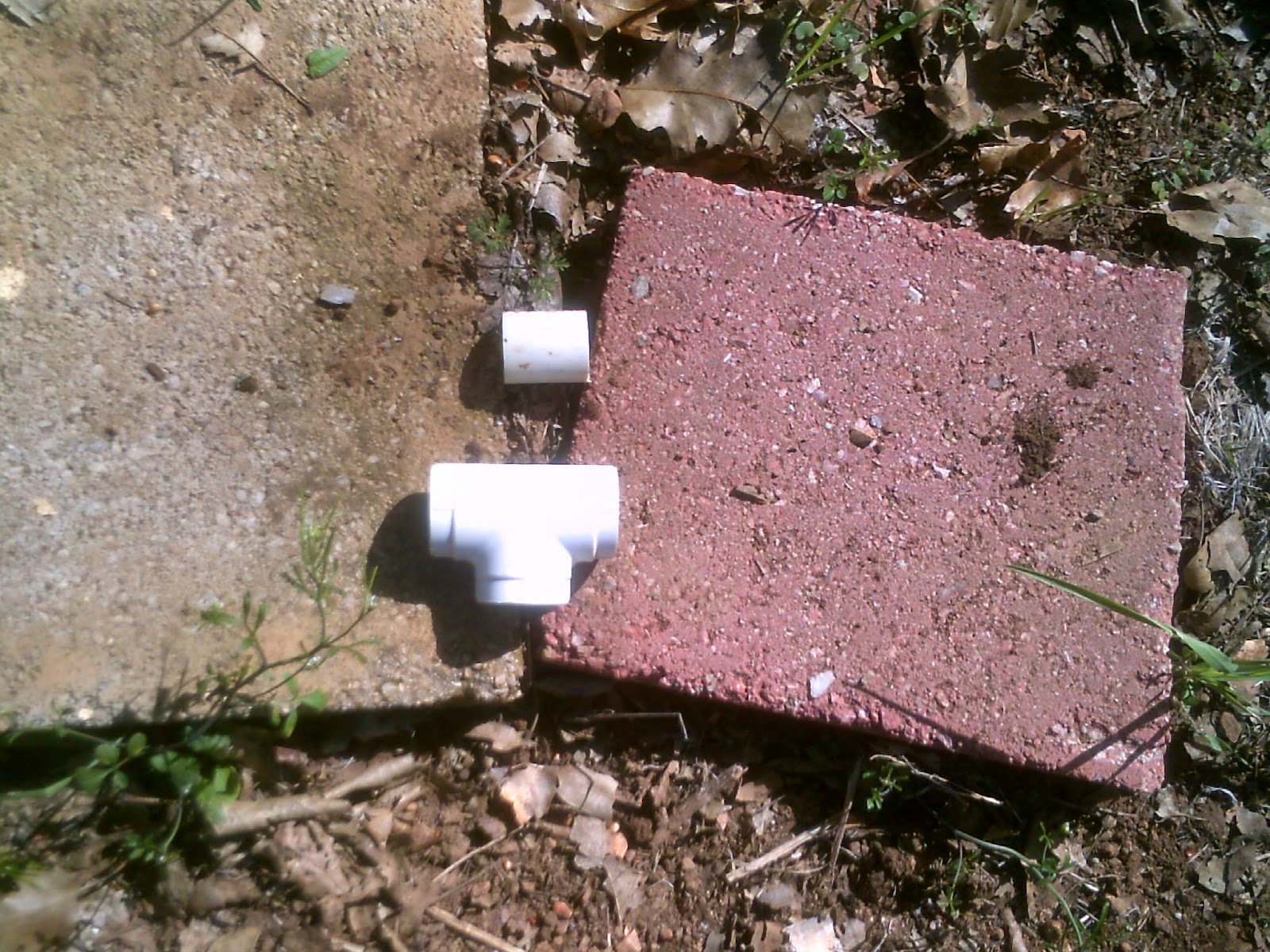
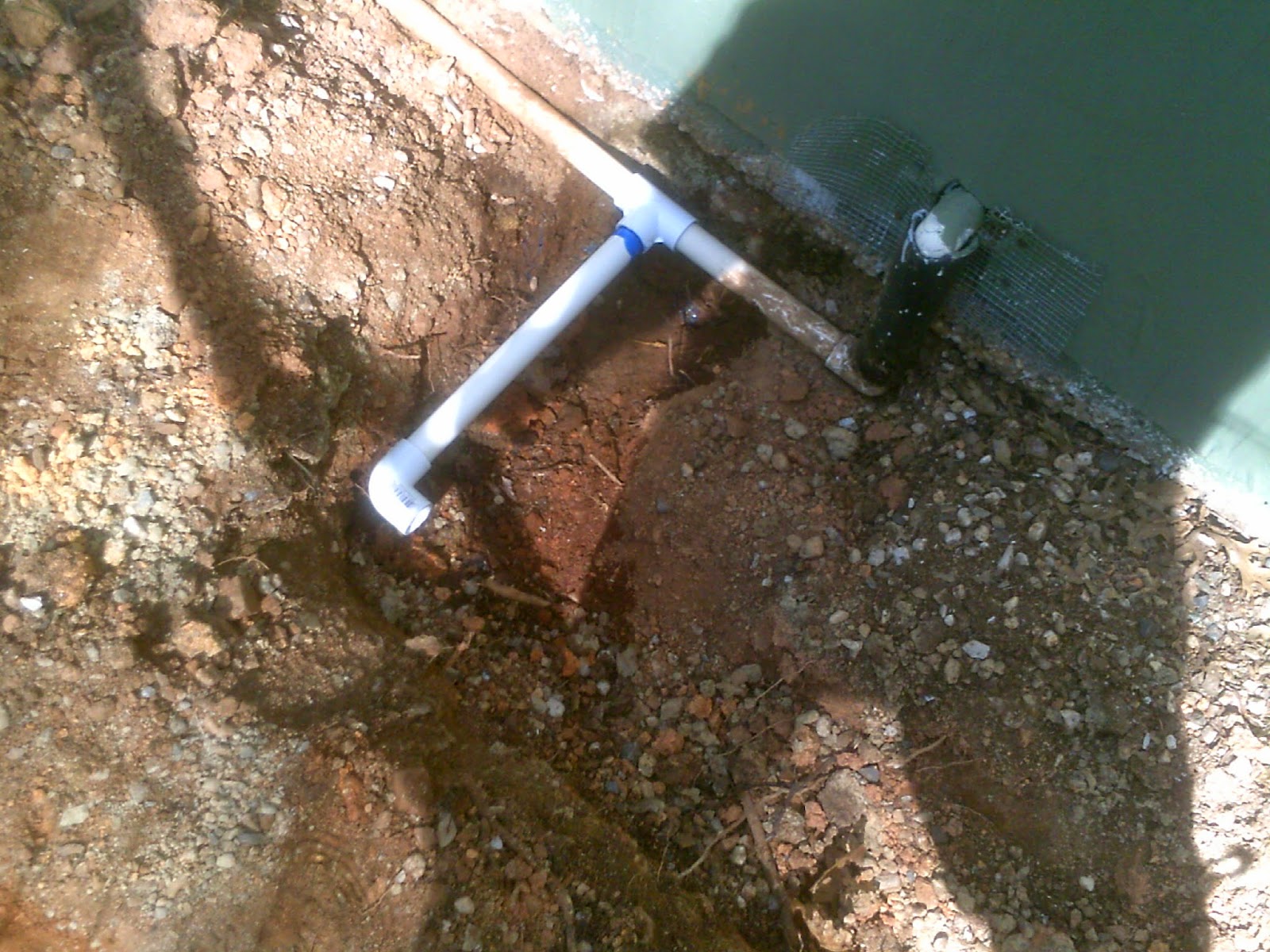
I cut about an inch out of the line (after, of course, turning the water off) to allow for the "T" above.  There was enough flex on either side to allow the "T" to slide right on in.
From there it was a 90 degree turn to the left, or the right, depending on where you were standing, and then I ran out another ten feet or so of PVC. 

And then I put in a shut off valve, so that when and if I have to work on the upper irrigation I can just shut off that section rather than the whole line.  I'm big on valves, apparently.

Next I ran about 6 inches out to a "T" and then stubbed out the mid section for later use.  That will eventually be the main line in for the back yard sprinkler system.
With that done, it was time to do my Geometry thing and take that PVC on up the hill to Chicken Fantasia Land.  But before I could do that I had to do a little cardio, you know, break out my trusty little trenching shovel and get to it.


Once it was all put together and tested, the final product looks a lot like this:


And one more project can be checked off my infinite list.

Ringtail Raider in the Night

Well, it almost certainly had to happen.  Maintaining fowl in the country is certainly NOT without it's hazards.  And the aroma of lovely, docile fowl in the middle of the country no doubt just begs night time marauders to stop on by to see what they might get a slice of for dinner.

The main coop where the main flock sleeps has never yet been breached.   They've been sleeping in there for over two years now, and considering the companion cage has been raided twice one would think if the coop was penetrable it would have been penetrated by now.  It has not.

But last year the companion cage door was breached and we lost Ginnie, the Guinea, to some night time invader.  Before moving our new chicks out there this year I made major improvements to the cage door, and it is now just as strong as the main coop door.

But I did not take into account the width of the space in the rectangular wire that the cage was essentially made of.  Strong?  No doubt.  Keeping the predators out?  Sure.  So what the heck then?

Well, as I have alluded to in many previous posts, when the night shade falls a chicken's metabolism falls too.  Just like Nick huffing some Krylon or Ozzy slopping down a pint of carbonated cough syrup, a chicken's brain turns to mush in the dark.

So the other morning, like around 1:30, my lovely wife and I were waken by some abnormal chicken noises.  Not a frantic holler, but a sustained low chicken chatter.  That's typically not good.  The dang rooster may occasionally crow, but the chickens are usually very quiet at night.  They can be noisy during the day, quite noisy sometimes, but after imbibing some of that dark evening night they're as quiet as little church mice.

So to speak.

Unless there's a threat.  I was up in an instant and hit the perimeter floods, 2 bright lights on all 4 sides of the house.  If you were out there sneaking around and I hit those lights you'd look a lot like James Coburn on the Band on the Run album cover.  The two floods on the East side of the house light up Chicken Fantasia Land like a Roman Candle would your hall closet.

We both saw a pair of bright eyes right by the companion cage door.  I quickly grabbed the always loaded 22 rifle and a bright flashlight and dashed down the stairs and out the side door.  Oh yeah, before I went out to tussle with the bad guy I did throw on a pair of sweat pants.  No sense in having that thing flapping around in the midnight breeze when engaging a wild beast. I also have a pair of sandals by every exterior door, which makes emergency dirt and gravel stomping tolerable.

The coop is only fifty feet from the house, I was there in an instant.  During this instant my lovely wife, doing recon from the master bedroom deck, watched the invader frantically scampering back and forth inside the exterior pen trying to figure out how to get out.  He was, apparently, not a big fan of bright lights in the night.  They seemed to agitate him. 

As I approached the front gate, I saw him perched on the top of a wooden gate post at the back exterior coop fence.  He sat there for an instant and then bounded down the other side and into the night. 

I then started an assessment.  The main coop door was locked and the main flock OK.  Upon looking into the companion cage, I noticed two of the birds were on the perch, one was sitting up in the garbage can (shelter) and one was laying down on the ground.  Not moving.  That was probably not good.

And then, about 20 feet away, Mr. Bad Ass's eyes and then full form appeared from behind a tree.  Two big, bright golden orbs in the night upon a cat like looking body, but with abnormally long legs.  With flash light in one hand and rifle in the other, I got off a shot.  A bad shot.  It was a miss, but Mr. Bad Ass, his form imprinted in my cranium, dashed off into the night.

Then I went into the what I thought secure companion cage.  The one bird laying down was headless.  How it got into the middle of the cage I don't know, unless, of course, it experienced one of those things similar to running around like a chicken with its head cut off. 

And then I noticed the Rhode Island Red in the garbage can had no feathers on her neck as well as a pretty severe wound.  Blood was not flowing, or dripping, but it was open into her second layer of skin.  Other than that she was moving OK.  I sprayed the wound with a spray on bandage, and (later that same day) she seemed to be doing OK.


Obviously I had to figure out the breach, and fortunately, with a couple tell tale signs I think I did.  The two other girls were still a perch, unfazed by the nights commotion.  They were both slumbering inches from the outer rectangular wire.  If I hadn't intervened they would have been headless and probably not even noticed until they were running around too.


It would be simple for a night time marauder to waltz up, possibly singing belligerently loudly, stand on it's back haunches and pull a chicken's neck through the rectangle.  Then a couple swift gnaws and wallah, a headless bird.  I am certain that happened to Jewell. 

Here's some blood evidence right on the gate, after my wire intervention, where I think the Rhody was accosted:

Most of my morning was spent adding small dimension chicken wire all around the bottom 2-3 feet of the companion cage, paying special attention to the areas close to the perch.   Actually, I ended up putting some wire up very early that same morning, like about 2.  I couldn't sleep knowing Punch Drunk and Judy were  sleeping inches from certain death, just like sitting ducks.

So to speak.


It all looks impenetrable and safe now, much more than before.  I think if something tries to get a paw in there it's gonna look a lot like Steve McQueen did after he wrecked his bike in "The Great Escape".  But then, I thought the cage was safe before.

As soon as I got back in the house I went straight away to my "Laws Field Guide to the Sierra Nevada" and ascertained the invader was a Ringtail cat, with about 90% certainty.  The Ringtail is not really related to the cat family, they are actually members of the Raccoon family.  Which makes sense.  This varmint looked like a raccoon but was much smaller, just like the rascal below.


By the way, if you live in the Sierras you really need to buy the Laws Field Guide.  It is packed with every bit of information about these mountains regarding flora, fauna, varmints and poop.  There's a link for it somewhere around here.


There have been no further attempts in the week or so since the initial attack.  The reinforced fortifications seem to be sound.  The Rhody is looking good.  Her wound has scabbed over nicely and should start to feather in before too long.

It looks like the 3 remaining babies will have to stay in the companion cage a few more weeks.  I briefly let them in with the main flock the day after the raid and the big girls were very much less than hospitable.  The babies are still pretty small compared to the 2 year olds, so I think they will need to grow a little bit more for their own protection before full integration with the main flock.

Next big projects coming up this summer will be the picket fence refurbishment excursion program thing and the front deck rail rain intervention Bossa Nova.  Who said owning a house in the country can't be fun?

Stay tuned.


Friday, May 9, 2014

My Gym Wears No Sweat Pants

I am soooooo lucky!  Color me crazy, but I've got an annual activity here that not only saves me a ton of money but also keeps me in shape!  This activity works out my legs, back, shoulders, arms, knuckles and spleen.   Every year since we've been here I have engaged in this activity.  It is not quite as physically exerting as Manzanita wrangling is, but it's up there on the list.  Pretty darn close.  Not only does this activity help me avoid exorbitant gym fees and the opportunity to wear sweat pants in public, but it also essentially heats our house for the entire winter.  What on earth could this fun and fantastic activity be?  Why, emulating Paul Bunyan of course!  You know, getting my lumberjack on.

Now don't get me wrong, we're not totally off the grid back woods country here.  There is propane forced air heat and that usually kicks on around 5:00 AM.  It's also set to kick off at 8:00 AM.  Kick back on at 5:00 PM.  (If the heat kicks back on at 5:00 PM, I have definitely NOT been doing my job and I am kicking myself in the ass!)  Long before 8:00 AM I usually have a fire going in our Vermont Castings wood stove, which is located in the living room.  With a ceiling fan in there helping to circulate the heat, the entire "hub" of the downstairs stays quite comfortable and toasty.  And since heat naturally rises, the upstairs bedrooms benefit as well. 

I have done a previous treatise on wood cutting (and Paul Bunyan), you can read all about those exploits here: Where's Paul Bunyan and that Damned Blue Ox?  For those of you who would believe heating your house with wood is archaic and contributes abhorrently to air pollution, understand wood is a renewable energy and ideally should not contribute to green house gas at all if it is perfectly combusted.  Most wood stoves these days are real good at combustion, ours has an after burner catalytic converter for crying out loud.  To take care of that pesky smoke and those inarticulate particles.  And increase mileage.

Fortunately, we have zero capital outlay as far as the wood is concerned.  Well, there are some tools required as well as tool maintenance.  Some gas, bar oil.  Chain sharpening (at the saw shop).  Total hard cost per annum about a hundred bucks.  Annual gym costs here are about $480.  So far I'm up $380!

Our propane use the last two years, meticulously chronicled by yours truly, has been 320 gallons in 2012 and 330 gallons in 2013.  Looks like our usage is fairly consistent.  Annual cost for 2012 was $1,150.88 with an average price of $3.28 per gallon, $656.05 in 2013 with an average price of $1.81 per gallon.  Looks like the price has not been fairly consistent.  Talk about a price difference.  Who's zooming who?

We also use propane for our range, clothes dryer and "on-demand" water heater.  That's it.  We do line dry the laundry when it's not raining though.  Listen to a little "All Day Music" when doing that.  That's the closest to perfect clothes hanging song I've come across yet.  Yeah, yeah.

Obviously heat would be the biggest consumer of the propane use, but I do my best at keeping that at a minimum with my wood workouts.  With our average propane cost of $55.00 per month and average electric bill of $87 (the last 3 years) we're doing our best at keeping our power footprint as small as possible.  Without wood intervention, our propane use would be incredibly higher.  As would the cost.  Estimated annual savings with wood workouts between $2,000-$2,500.

Our electric bill peaks July/August/September now that we've installed a couple actual air conditioning units.
Prior to last summer, the only cooling system here was an older swamp cooler that was installed in the kitchen dinette.  That and a couple native swamp people in loin cloths with fans running around on really HOT days.  Or were those freaking hallucinations again?

The swamp cooler worked OK in the morning hours when it was in the sun, but in the afternoon it was in the shade and would start blowing warmer air.  When we needed cooling the most it was hardly working at all.  Then, come to find out, swamp, or evaporative coolers work best when situated in the full sun and the water is evaporating at a rapid rate.  Their cooling effect is MUCH stronger.  Kinda like your home made ice cream maker.  You add salt to the ice to melt it so it gets colder faster.  What can I say, it's science. I didn't make it all up.

So last summer my lovely wife and I purchased 3 window air conditioning units.  The largest one replaced the swamp cooler and I have to say, it is utterly fantabulous to have ice cold air blowing in at 4:00 in the afternoon.  We have put another smaller unit in a master bedroom window, and there is another small window unit behind me, here, where I sit in the office.  If you want to call it that.  One day I must write a treatise on where I write.  With all the odds and ends and pictures and knick knacks and stuff, crap collected over the mystery of my life, I am certain there will be a worthwhile tale or two in there.  Somewhere.

We also have a portable A/C unit, which was in the master bedroom the first couple years.  The portable unit works great, but it does take up a little bit of room.  And when that little bit of room is on your lovely wife's side of the bed, you gotta figure something else out.  Quick.  Now the portable unit sits out in the sun room and makes for some nice cooling when we get a house full in the summer time.

But it's not summer yet, it's spring, which is, generally speaking, the optimum time to get your firewood down for the upcoming winter.  Damn, maybe that's why time keeps hurtling along so fast.  I'm already manhandling next winter's heat.

I have learned over the last couple years that it's best to get the trees DOWN before they start leafing out in the spring.   That way you end up with a lot less flammable "slash" once you've brushed up the limbs.  Less work too.  I'm all about less work.

So a few weeks back I noticed some green starting to sprout on all the oaks around here.  That's my sure fire signal that I'm running behind and I need to get my wood down for the upcoming year.  Fortunately, since I'm usually in the middle of eighteen other things, dropping the trees is the quick and easy part.  Once down, they won't leaf out and they can just set for a while.  The wood needs to "season" anyway.

When the realization hit me that I needed to get the wood down, I got out and warmed up my trusty little Echo chain saw.  And then I went to town.   I felt like Freddie Krueger at a summer camp chain saw musical madcap massacre in Ohio.  Singing Oklahoma.  Or was that Kansas?  Looking for Toto.  On a Crazy Train.  Am I hallucinating again?

It only took about 45 minutes, but during that whirlwind I downed almost as many trees as Mt. Saint Helen's did when she blew back when.  Apologies for the out of focus pictures below.  Several shots were taken before I realized the camera was set on "Micro".  Unfortunately, the downed mass of a mess was already half cleaned up before this realization.


Hopefully you get the idea.  All the trees cut were under the main canopy, and their demise will only help the remaining trees to flourish.  I probably have another year's worth of wood in this section of land, maybe two.  Thin them out so the remaining ones flourish.  It's prudent stewardship.  I dropped about 20 trees ranging in height from 20 to 50 feet, and from 8 to 12 inches in diameter.  Each one came down without a hitch, which is always a good thing.  Tugging on a "bit" tree with a rope and chain is really taking the workout to a new extreme.  Fortunately, I have only had to do that twice now.  And fortunately the trees weren't too big.

Since I am an ex-firefighter and prone to being somewhat anally organized, I thought I would brush up the trees and try to get a last burn in with the last rain of the season last month.  (Even if it is a "legal" burn day here in the county, I won't burn unless it's around a rain storm, right before or after.)  Instead of letting the trees lay, I went out to my gym and played.

First I gathered up my trusty loppers and jumped right in to the thick.  There's a little shoulder and forearm action.  I'll generally take off what I can easily cut with the loppers, usually up to an inch or so. That's the throw away slash.  The rest is fuel.  I'll take a tree that looks like this:

And make it look like this:
I keep more of the tree for fuel than most.  Most folks only keep wood that's 4 inches or more in diameter.  I keep stuff at 1 plus inch.  It's perfect kindling.  I could either spend time chopping kindling, or lopping it.  I choose lopping.  I end up burning more of the downed fuel efficiently that way.  Less work too.

Then I take my trusty little Echo chain saw and cut the tree into manageable lengths.  More shoulder and forearm work.  I won't cut it to firewood length until it's down near the stack, unless, of course, the cut is down near the trunk.  Then I have to cut to burn length, otherwise it'd be too heavy for me to move.  As the diameter of the tree decreases, I can increase the length of the pieces.  If I cut it all to burn length in the field I'd be moving a lot more PIECES of wood.  The weight's the same, but there's less pieces to move.  Less work.  And I'm all about less work, especially when I'm doing a lot of it.   


I pile up the burnable slash around a shoe box size little pile of dry sticks.  Then I cover the dry pile of sticks with plastic and wait for rain.  Do a little dance.  As long as I have that little shoebox, I can get recently rained on slash cooking into a towering inferno.

It rained a couple weeks back.  It all now looks like this:


The wood is now stacked and bucked into easily transferable pieces.  All that stacking and bucking works the legs and back real good.  Spleen too.  Somehow.  Over the next few months I will slowly get it all down to the wood cutting staging area.  That's the dirt turn out across the drive at the top of the picture below.  


Firewood is a constant couple hour a week chore.  Cutting it or carrying it.  Now that it's cut, I will spend a couple hours each week slowly bringing the wood down to the staging area.  Once it's all down there I will then start to buck it into 18-21" lengths.  From there it is only 20 feet to the wood stacking area.  From there it is only 30 feet to the covered front porch.  From there it is only 10 feet through the foyer to the wood stove.  It's the most dang efficient route this ridiculously anally obtrusive individual could think of.

Keep in mind, if you'd rather avoid gym fees for a week, you can come on up and get your lumberjack on working with firewood here.  Anytime.  Just call.  I won't even charge you a cent. 

Fowl Update

Our little chicks are rapidly turning into gangly adolescents.  They have out grown their makeshift cardboard brooder and are now in the Companion Cage.

I have recently solidified the cage door, adding hinges and a latch.  Now it will take more than a hard tug to get open.  The last time the Companion cage was used was not quite successful.  You can read all about that at The Companion Cage/Massacre at Keet Creek...

Our new girls will reside in the companion cage for 3-4 weeks.  They now have plenty of safe room to roam, and they are right next to the main flock cage.  This way they all get acquainted without ruffling anybody's feathers.  When released, flock integration should be seamless.  The Guinea Hens integrated fine, it was the actions of the inexperienced owner that sent them to their demise.


The garbage can provides shelter just in case we get a little spring rain.  And we always get spring rain. We've had some rain the last couple days with night time temperatures dipping into the low forties.  The chicks have weathered that change just fine.  Next week it's supposed to get into the eighties.  Here comes summer.

A very Happy Mother's Day to all you wonderful Mama's out there.