Monday, March 31, 2014

Up To My Elbows in Angles

I was never very good at geometry.  The only reason I passed high school geometry was because the varsity baseball coach was also the geometry teacher.  Since I had to have a minimum of a C in every class to stay on the team, I got a C in geometry.  I have no idea how. I don't think I passed one test.  You know, like, isosceles this, you oblique, obtuse thingy.

Fortunately, my mind's eye can usually see the dimension in it's full glory without having to figure out the square root of its hypotenuse.  It's also a good thing I don't have to sine or cosine when I'm hyphenating an apostrophe.  I wouldn't have the foggiest notion of what I was doing.

So, I was down watering the orchard the other day a couple months ago before the rains came.  Why was I watering my 4 tree orchard in the middle of January?  Well, because we hadn't had any rain in these here parts for a while.  So I did some drought research and learned that fruit trees should get a minimum of 5 gallons of water per week per inch of trunk.  Since it really hadn't rained for a while, they were all getting a minute's worth of water.

I was going to add a few more fruit trees to the orchard this year, however, I decided not to until we get some sustained water from the sky.  Eventually I'd like to have about 16-18 semi-dwarf fruit trees, a variety of course!  And semi-dwarf so I don't have to climb an 80 foot ladder just to eat a peach.  I'm not getting any younger you know.

Right now I have 2 peach trees, 1 Santa Rosa plum and 1 Honey Crisp apple.  I'd like to add a couple more apple, a couple cherry, an apricot, a pear, a pomegranate and who knows where from there.  Since we get snow at our 2200 foot elevation generally a couple times a year, citrus doesn't work so well unless you can greenhouse them.  Olives do well, I may plant a couple of them.  We'll see.  I've got plenty of room.

Here's our two peach trees below, you can just make out the January blossoms.  The Perez peach, so named for the good friend that gave it to us, is the one in the background.  Last year it bore fruit, a half dozen sumptuous, delicious white peaches.  Lots of blooms were danced upon by bees this year, and so far we haven't had a freeze since they blossomed.  Hopefully we'll have a bit larger bounty this year.  We've got a couple established fruit trees by the house that haven't bore fruit since we've been here.  In the last 3 years as soon as they blossomed snow came and froze the giblets.  It's been a warmer Late Winter Early Spring this year.

Oh yeah, in case you haven't noticed, all our fruit trees are encased with a 6 foot high fence.  Until they get a bit taller.  If they weren't encased the dang deer would reduce them to rubble in a heartbeat.  You can read more about our deer problems here at Bambi Can Eat My Drawers.

It was upon this mid January watering that I noticed the hose spigot near the propane tank at the bottom of the property was leaking.  Dang!  We can't tolerate a water leak anywhere.  We're on a well, and we're dropping a gallon of water an hour to no where for no reason?  With an impending drought?  This is a friggin emergency.

I have had some irrigation thoughts for this area for a while and decided, if I was going in, I was going in all the way.  I had most of the materials, you have to when you live in the country, but headed into town for a few more just in case.  I loaded up on PVC fittings from Restore, a recycling place, and then went to a local hardware store for a couple more specific items.

When I returned, I got all my tools and all the materials together and trucked on down to the lower 40.  Besides fixing the leak, I wanted the leaking hose bib attached to a post.  I have another hose bib up near the parking area that is simple PVC rising, like this, and a strong tug on the hose broke it right off one morning.  Then I had 15 foot geyser and a frantic chase to figure out where the nearest shut-off might be.  Turned out that one I had to turn off at the well.  Dang.  I had to shut off the entire house.  Everything.  Everywhere.  And then I did not have the needed PVC fitting, so I picked up several when I went to the store.  Just in case there's a next time.

Seems that when they punched in the new well some years back they made a couple outlets directly off the main line coming up to the house.  So if something goes south on that line I've got to shut it down at the well.  On the other side of the property, I've got one shut off that only affects outside water and does not effect the house.  That is fabulous when there is an upcoming freeze.  I can turn off most of the exterior water outlets at one location.

So if I am securing the bib to a post, I'm gonna need a post, which would also require a hole, a short 4x4 and some concrete.  But then, before I even went there, I decided to install a shut-off valve at the bottom of the hill.  That way the rest of the line, and there are about a half dozen other branches off that line, can remain active whenever I might have to work on the irrigation in the orchard.

First I shut off the water at the top of the hill.  Then I dug around the existing bib, which is located next to the propane tank, about 250 feet downhill from the house.  That was one thing the previous owner idiot boy did that was good.  He had the propane tank located down near the road, which not only makes it safer for the house but keeps those heavy propane tankers off most of our Lombard Street drive.  He did a few good improvements, maybe 4 or 5.  And about 4 or 500 WTF'S.

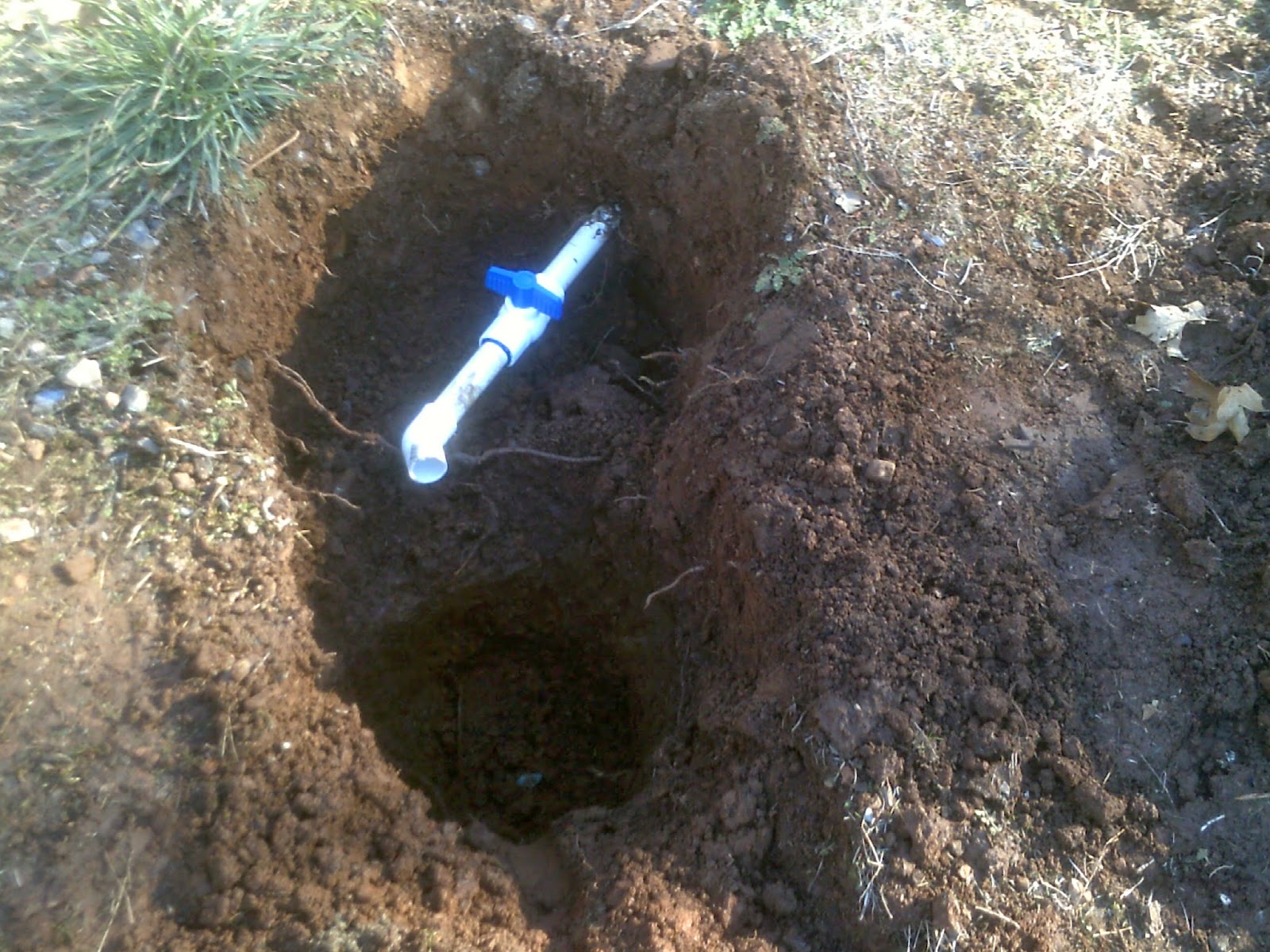
After digging for a minute or two, I carefully uncovered the end of the line and the 90 degree elbow swinging up to the attached bib.
I removed the bib for reuse, dug the hole for the post, and then dug back a little on the existing line to allow room for the shut-off valve.  Then I got my PVC snippers in and cut the line.  By the way, the notorious,  hard foothill clay slices like butter when wet.  Remember the bib had been leaking?

Once that was done, I slathered PVC cement on one of the female ends of the valve and put it on the line.
Now I had a shut-off valve at the bottom of the hill.  Boom.
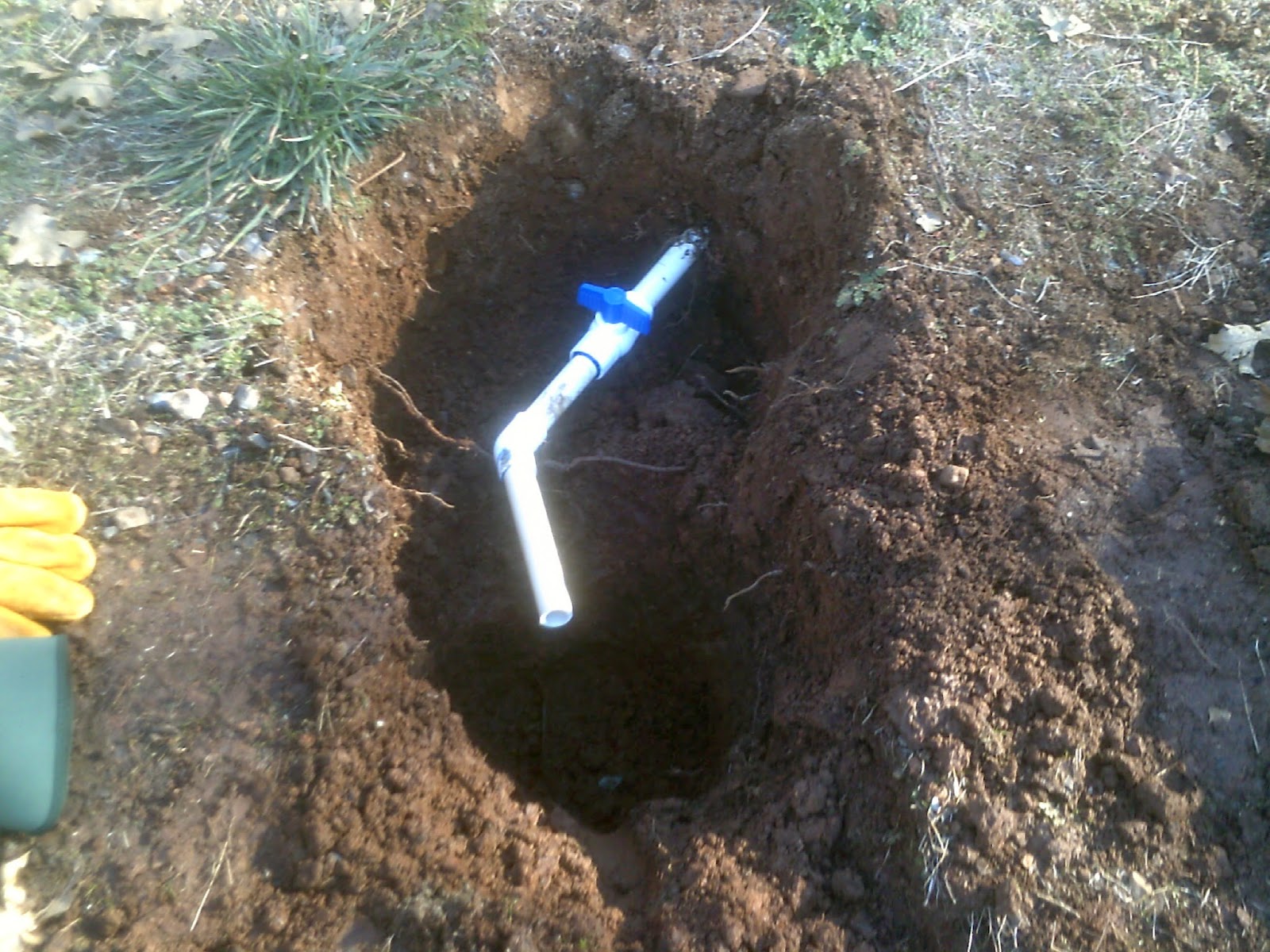
Next was a little 45 degree action so the line would run right next to the post and also meet up with the trenching across the lower gravel drive. Eye-ball to angle.  Scalene that, baby.
Next I put the round housing unit over the valve for protection, just in case.  There was a lot of activity going on.  It also made for a nice radius.  Or ulna.  With a diameter in between. 

Then I added a "T", a 3 foot rise and a 10 foot section horizontally so I wouldn't get any dirt in the end.  Oh, yeah, I also popped in the post to size it all up.  That would be my own ambiguous theorem. 

Once everything looked OK, I mixed up some concrete, filled the hole, leveled the post and called it a day.
The next day, after the concrete had dried, I came back to play.  Once I had attached the riser and bib to the post, I discovered I had a bit of an elevation thing going on in the trenches.  PVC will bend, but it's got to be a gentle curve.  What I had going on was too extreme and was going to require some mumbo jumbo.  Some angularity.  You know, geometry.  First I had to cut the 10 foot section right where the drop began.
And then I mumbo'd and jumbo'd with a couple of 45's.  Kind of like doing a hypotenuse trapezoid or a hexigonal diagonoid.  You know, it almost sounds like I'm making this up. 
And then I ran the line through the trench I had scratched across the drive, ending just on the opposite side of the cedar wall you'll be introduced to shortly.  I  glued an end cap on the line, covered the trench and called it a day.
Here's the finished part of that project for the then moment-
I quickly discovered it was a pain in the patoot trying to turn on the water with that valve when it was up against the post, so I cut off the post with my trusty hand saw and this is the final result after a coat of brown paint. 
Another good thing the previous owner homeboy moron did was start a partial line of cedar trees that run parallel to the main road and act like a bit of a hedge of privacy for the front of the house.

Unfortunately, due to some oaks impinging on their territory, there are several bald spots along this hedge.  I picked up a few volunteer starts, like 30 or so from a friend's place a couple years ago.  I promptly potted them and have expanded their pot size a couple times.  Since the ground had been saturated with about 18 inches of rain in the last month in a half I figured it was time to set a few free.  Fifteen of them made it into the ground to fill in the vacancies.  Once established, they should grow a foot or two each year.
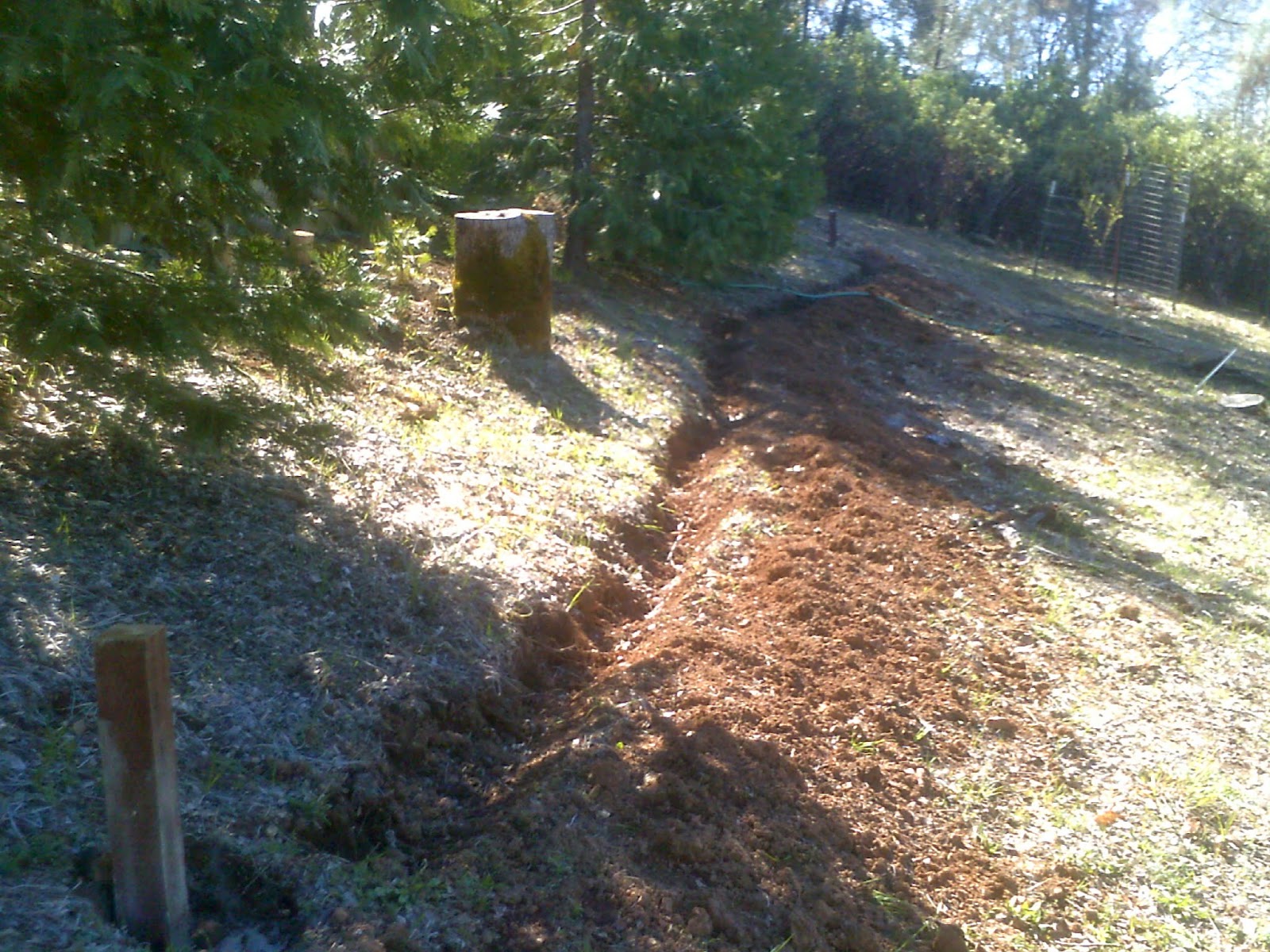
And since the ground had been so saturated and was so soft, I decided to dig the trenches to complete the orchard irrigation.   

And so I dug, as straight as I conceivably could, without running a line.  And since the ground was so soft, I decided to dig the holes and put in the posts for the two hose bibs on either side of the orchard I had envisioned somehow somewhere.  I got lost in a pure excavating frenzy.  Have shovel, will dig. 
It all seemed more or less straight when I was digging, but it ended up not quite being the straightest of lines. It's kinda how I operate tho.  With just a wee bit of a soft edge.  It almost looks like the line is smiling towards the west.  Or maybe it can be a mustache.  Who cares?  It's all covered now anyway.   
And then I left it all for the day to let the concrete dry.  Actually, I think it was another week or so before I got down to run the lines.

FIRST, I turned off the water at my newly installed valve, not the top of the hill.  And then I had to locate the capped end I had buried so many weeks back.  Fortunately, I stacked a couple rocks a the location and it was a snap to find.

Then it was snip, let the line drain (since this was it's lowest point),"T" time and run the line to each side.  (The above supply line was left somewhere near the middle of the orchard.) 
I made sure there was enough line at each post.
I had to do MORE geometry at each end due to elevation changes, but it all went acutely well.
Once everything was attached I tested the line and fixed 2 leaks.  Then I retested the line and let the water stay on for 5 minutes.  Everything held.  I tossed a little dirt on the line and added a little brown paint on the risers. 
By this time, most all of the muscles in my body were aching.  I had been doing physical hard stuff for two days straight and this old body was barking.  Usually I try to space out the hard stuff, but every once in a while days collide.  My back, my shoulders, my thighs and Steve, my ankle, were howling.

Hobbling along, I gathered all my tools and equipment, tossed them in the truck and drove back up to the house.  With every fiber aching, I shuffled around and put the stuff away (every thing has a place and every place has a thing-one of my rules to live by), shuffled into the garage, sat down and freed Ed and Steve, my ankles, from their very safe housing units.  Or boots.  I suppose most folks refer to them things as boots.

I shuffled inside, popped about 18 Ibu's, showered and sang Babaloo.  It felt good to be square again.

Animal Update

The kittens have taken a shine to scampering outdoors first thing in the morning.  It's usually still a wee bit dark, and it usually happens when I open the front door to empty the wood stove ashes and get some kindling.  We're still lighting fires here in the morning to take the chill off.  Actually, today will be a day long fire, it is raining as I write. With possible snow tonight at the 2500 foot elevation level. 

Once the fire is started and the coffee is dripping, I usually yawn and wake up.  Then I'll pour some coffee, clean out the cat box and toss that and the recycle out the utility door for future deportation to the garbage depot.  When it's light outside.

One morning a couple days ago I was a little delinquent with the recycle and it was light by the time I opened the utility door.  And there. laid out ever so neatly, was a dead little bird.  A present from one of our little girl kittens to be sure.  I have witnessed them attacking a lot of bugs, and now one of our feathered friends has made their list.  The first, but certainly not the last.  Now if I could only train them to attack deer.

It would be nice if they could restrict their hunting prowess to our four legged furry little rodent friends, but unfortunately that would not be the case.  I fear a fair amount of feathers will fly during their lifetime(s).

Our intrepid hunter Tom Cat caught birds all the time.  Ate 'em too.  Ate everything except the beak and legs.  Then he'd burp feathers, just like Sylvester.  I'm kidding about the feather burping part.  But not about the beak and legs. 

 I also pity any lizards around here this summer and for the summers to come.  Those that do live will certainly be tail less, which is probably better than being clueless.  And they don't shake their tail that much anyway, I don't think lizards listen to very exciting music.

They probably listen to really insipid stuff, like that Pina Colada Song.

OK, if you listened to that then you certainly can't let that be the last tune to twirl about your cranium.  Try this relatively new one out from Toad the Wet Sprocket.  The kitties both really like this song and listen to it all the time while they're tearing up the living room.

Sunday, March 16, 2014

Taming our North West Territory

Who can remember the Crazy World of Arthur Brown and his song "Fire" from the late 1960's?  A one hit wonder to be sure, only I'm not sure if it was even a hit.  I think I bought the damn album, probably after having one hit too many myself.  Speaking of hits.  And if you view that video, you're probably gonna need a hit yourself.  Probably upside the head with a 2x4.

Supposedly we're having a drought here in Northern California.  The storms we had in February dropped 12 inches of rain at our little farm house over a 4 day period.  And more recently we've received  7.75 inches of rain so far this March.  That's almost 20 inches in the last month and a half.

That puts us at roughly 28 inches for the water year, which runs from October-October.  Average annual rainfall here is around 51 inches, so we're a little over half way there, with hopefully a spring storm or two yet to come.  The drought is not quite as bad here in the Northern California Sierra Nevada foothills as it is, say, in Monterey County, LA County, or the Gobi Desert.  For instance.   

I'd like to think I had something to do with the rain, kinda like a counter balance sort of thing.  In preparation for the drought and wild fire season, I decided to get back to some land clearing.  More specifically, getting rid of all the dead brush and underbrush from around the ground here.  I don't think this property has been cleared up in oh, say, ever.  And as soon as I started all that back breaking work the rain started as well.

I have already cleared quite a bit of the ground; wrangling manzanita, poison oak and blackberry brambles over the last couple years.  A little bit here, a little bit there.  As a matter of fact, when I burned the mess below, which was taken from the opposite side of the drive, I also attacked a blackberry bramble that was about 15x20 feet.  You can see it in the middle photo, just about direct center, back near the drive.  That thorny mess was plowed out with a pair of loppers, sweat and a hell of a lot of sheer determination.


 And wallah, a so much cleaner look now coming up the drive.  Or going down the drive.  If you've come to visit for instance. 

You all may be wondering, what the heck do I wear when I'm up to my waist and elbows in thorny blackberry and thirty foot long snakes of poison oak?
(Here's a pile just to let you know I ain't  kidding about the poison oak.)
(It's always best to catch the vines dormant.  They're still lethal, but there's less to deal with.)

That's all quarantined poison oak.  I try to keep it separate from the other brush so I know when I'm tossing it on the flames.  I'll get the pile cooking, do a quick wind check, toss the poison oak on and then take a stroll.  Or go to the other burn pile.  (I usually burn two piles at a time.)  I've dealt with at least 10-12 piles of poison oak that size this year so far.  Trunks an inch thick, with the vines wrapping up and around neighboring manzanita and trees 20-30 feet in length.  Yeah, I deal with some poison oak.

So what do I wear when I go swimming in blackberry thorns wrapped in poison oak vines?  Do you care?  Well, I'm certainly not naked, that's for sure!  From the ground up I got a nice, thick pair of socks underneath high top steel toed boots.  Then I have on a pair of Levis baby, denim blue.  A worn T shirt, and then a long sleeved sweat shirt an old firefighting friend gave me over a decade ago when he had a bike shop over in Carson City, NV.
Big Dawg Baby.

My friend ain't at there anymore, he's since moved on.  I probably wouldn't call that number hoping to talk Harleys.  You'll probably get a dry wall contractor and he'll only want to talk about dressing in drag and high heeled shoes.  It never ceases to amaze me.

I have been in the thickest of thick manzanita with that sweatshirt on, and for those of you who don't know, manzanita has hundreds of little nail to pencil-thick off-shoot shards which are hard, sharp, and lethal.  I shred T-shirts, every time.  The sweatshirt, when I get caught up, shreds the manzanita sticks.  It is like wearing Kevlar or impervious armor.  Big Dawg does it all.

My ensemble is completed with a pair of work gloves and a bright yellow ex-firefighter baseball hat.  I try to wear bright when I'm working in the sticks.  It's always easier to spot stuff when it drops in the brush or leaves.  Especially me.

And then when I am done burning or wrangling, I ALWAYS shower with Fels Naptha Soap.  I think there's a link for it somewhere around here.  By the way, please visit my Amazon (and other) links.  It helps pay the bills around here.  Thanks. 

I scrub a dub dub all exposed skin, my face, neck and shoulders especially.  If I've gotten too hot, taken off the sweatshirt and shredded a T (6 shredded so far in the last year, one of which was a favorite SF Giant T.  Damn!  That's why I said worn T up above.  Never again will colors be worn and then shorn!), then I really have to pay attention to my upper torso and arms.  And if I've taken a leak...

So far in 3 years of wrangling poison oak I have only gotten one small case of it on one of my forearms.  And that was no where near a wrangling or burn day.  I think that case was kitty related.

So I have cleared here and there, but I have never touched the NW Territory, which is part of the Lower 40, and no doubt the deepest of the Deep Side.  It's about a quarter of an acre to the left of our drive that's to hell and gone and away from the house.  It also sits right on the main road.

Here's a few before and after shots of what the jungle looked like and what I done!

(That's my long standing wood chip pile sign. I have a standing order with a tree company down the street that they can drop off excess chips any old time.  Now I just need more gumption to spread 'em around!)


The brush was thick,  Thick as a Brick.  There were also about 20 or 600 one to four inch thick pine trees 20 to 30 feet tall flittin around.  Vines of poison oak.  There was also a blackberry bramble around the solo remaining pine tree above, with dead vines arching out of it's thicket like long, menacing octopi arms with razor sharp teeth.

Obviously I left the big oaks and most all the trees and brush along the road side cliff.  That rises from about 1 foot high at our drive to 12 feet high at the fence line.  I want all the root I can get along that embankment.  I also left most of the manzanita, which can be quite artsy, especially when given a chance to branch out.  I also left that solo little pine, which has a lot of room now to grow into a solo BIG pine.

Below you will see my simple tools of the clearing trade.  That's my second pair of loppers, the first pair lasted a couple years until I shattered them on a dead, inch thick branch of manzanita.  This one's only been in service for a couple months and is already war torn and weary.  I already have a back-up just in case.

And that's my little Echo ES310 chain saw with a 14" bar.  Don't need a longer bar, don't want one.  I can slice through any and everything with this as long as the chain is sharp.  If I'm bucking a log that's a couple feet in diameter, I slice down one side, roll the log and complete.  Using a small saw like that saves a heck of a lot of energy over using a heavier one with a longer bar.

My bright orange bucket contains all the necessaries for the chain saw, including bar oil, another chain, fuel, ear and eye protection and other assorted sundries.  Mostly all bright orange, cause I said, when you drop them in the forest they are really hard to find.  Like me.

So away me and that little party went, four to five hour spurts over a three day period amassed enough brush to fill and consume a 1200 square foot house.  At least.  A lot of back breaking work, especially for an old man, but ever the more better for being done.  I'd so much rather burn that stuff on my terms rather than let a wild fire have its way with it all. 

I scheduled the burn around the last rain storm with two burn piles and about 25 piles of brush scattered hither and yawn, most about 15x15 and four feet tall.

Since I have a lot of trees, I have to be selective where I locate a burn.  Besides the laterals I also have to be concerned about the overhead canopy.  Fortunately, once all the crap was cut I was able to situate two close-in locations where I could get the fire cookin.  As it was, the fire ran into the nearby leaves at both locations.  However, I ALWAYS have a charged hose line nearby as well as a 3 gallon water extinguisher.  I went out on a number of "out of control" control burns back in my firefighting days, I don't ever wanna host one.  I let the fire run a little, but kept it corralled, essentially expanding the safe zone.

It took about seven hours to burn all the brush with 2 fires going, but I blasted through.  I couldn't move for three days afterward, but I got her done.  That night rain came to extinguish any leftover ashes, the perfect end to a long burn day.

Before going to press I just finished possibly the last burn of the season on the upper 40.  I had already wrangled out a bunch of dead manzanita,  it just needed to disappear.  And disappear it did.  The ground around here is slowly beginning to look a little park like, AND, it is so much more wild fire safe.

Animal Update

Goldie, our Rooster and his 8 girl harem are all doing fine.  Goldie, however, is barely hanging on in our good graces.  He pecked our Granddaughter the last time she was here, so he's on a real short leash now.  BUT, he finally engaged a few weeks back and actually defended the girls for a change, so I'm a little torn.


I was up here, writing away, when amazingly with windows closed I heard the chicken's distress call.  I flew down the stairs and out on the deck to see what was the matter.  Three of the girls were in one corner of their fenced in yard, shouting like crazy.  Then, as I rapidly approached, a hawk skirted out of the chickens secure area, somehow lifted itself up and through my webbing and then over a 4 foot fence.

Let me back up.  First of all, I leave the hen house door open during daylight hours.  It is locked at night to prevent night predators like raccoons from beheading and dining on my girls, but it is left open during the day so the chickens can come and go as they please.  Get a little exercise.  Chit chat, smoke cigarettes and eat bugs.  That sort of thing.  Since the last hawk attack inside their yard (see Homestead Update at the end of Three Phases of Steve) I thought I had put up enough of a webbed deterrent so that we wouldn't have to worry about hawks anymore.

But I had left open to the sky a small 8x10 fenced in space, which is still inside their main fenced in area but separate from their yard, utilizing horizontal webbing to theoretically cut that space out from the rest of their play area.  Confused?  Me too.  Anyway, it was through the horizontal space that the hawk entered and then tried to leave.  But after the hawk got into the 8x10 space, he stopped on the ground and was leaning up against the fence.  He was giving me the evil eye and snarling (if hawks could snarl), and then I noticed one of his wings was in disarray.  As I quickly tried to think of my next move, Mr. Hawk finally launched and flew hap-haphazardly and slantingly up into a tree about 50 feet away. BTW, all of this, from the top of the stairs to eye contact with the bird, took place in the span of about 20 seconds.  Snap.

Once the threat was gone it was time to ascertain damages.  It was then Goldie emerged and I noticed he was limping.  The other five girls were hiding in the hen house and they were all fine.  Then I noticed there was a slew of Goldie's feathers scattered about.  NO blood, just feathers.  About the only thing I can figure is when the hawk came calling he was greeted by Goldie this time instead of a docile hen.  Although Goldie limped for a couple weeks afterward, I'm pretty certain he did some damage to the wing of that hawk.

I have since completed aerial webbing all across the top of their Chicken Fantasia Land.  Hopefully that and a recent taste of Rooster will keep them hawks at bay.

Lastly, our kitties are doing fine.  Their little bellies are getting bigger, but they are still kitty through and through and a sheer delight for my lovely wife and I.  We are letting them out during the day now, and they are honing their hunting skills on flying insects, kinda like a Dog and Butterlfly.  We can't wait until they are honing their skills on little furry rodents.  

We do have them come in at night.  The kitties, not the rodents.  The kitties MUST come in at night.  Some of the same predators that would dine on our chickens would also dine on our little felines.  They're not quite ready (if ever) to take on a fox, bobcat, coyote or raccoon.  After the sun sets we call their names, and, smart as their little kitten brains are, they usually come scampering to the front porch within a couple minutes.  Bless their little feline hearts.

There's a big, wide world out there for them to explore, a lot of music to radiate within their little cat craniums.  I can't wait to see what they're listening to on a day to day basis.

                    Lily just woke up.  She's listening to a little Tom Jones.                    

                                   
                                          Daisy's still napping.  She's listening to some Byrds.

Wishing everyone out there, especially all my Irish brethren, a grand St. Patrick's Day!  


Saturday, February 8, 2014

Manzanita Trail Rails

Before I started the trail rails and before I launched into the multitude of thousands of projects that have been waiting for me since I was idled with Steve's (my right ankle) resurrection (see The Three Phases of Steve), I wanted to make sure he was going to be OK once I started wandering this hilly ground again.  So I got me a pair of these:

I had to get two of them because Steve has a brother.  So whatever I get Steve I've got to get Ed.  Yes, my other ankle is named Ed.  I have no idea why.  Or how.  As you can see, the boots are getting broken in.  They're already wearing the results of a few days worth of manzanita wrangling as well as an all day brush burn.

Anyway, here's Ed and Steve with their new dance shoes on:
These babies are high top AND steel toed.  Steve feels very secure and if I drop a big rock on my foot, more than likely my toes won't break and I'll still be able to dance.  So I got that going for me.  Now I can really go out and kick me some kaboodle!   But probably not too soon.  Steve's still a little painful to waltz around on, especially with those high top dance shoes on, but I can tell he is definitely on the mend.

Ever since the Deep Side Trail was completed, I have wanted to put up some railing along them steep steps that are all part of the trail system.  Prior to Steve going under the knife, I dug me some holes and sunk me some posts.  I decided to go with treated 4x4's for the posts.  I figure they'll outlast me at this point, which is what I want.  I don't want to be revisiting anything I do around here if I can help it.  I bought 3-10 footers and I cut them all in in half for my posts.  I need three for the Deep Side stairs and I need 3 for another set of stairs elsewhere.  I figure 2 feet in the ground is plenty, with roughly 3 feet above.
 
Then I dug me 3 holes along the stair route, one at the top, one in the middle and one at the bottom, all three roughly 2 feet deep.  Give or take.  This isn't rocket science, and if one is a little higher than another so be it.  I think the slope will assuage away any elevation differences to the undiscerning eye.

Then I mixed me up a little concrete.  At this stage of my game I generally use either a 50 pound bag of fence post mix or a 60 pound bag of ready mix.  I'm getting too old to be tossing around a 90 pound bag of concrete.  I can do it, but then I won't be able to walk for 3 days.

That's my trusty red wheel barrow below.  My brother gave that to me for my birthday about 35 years ago, it's still running strong.  It used to be sky blue though.  But what with the sweet salt air of Monterey a decade or so back it started to get a little rusty.  So I lightly sanded it and gave it a new coat of paint, red this time.  I think a red wheel barrow looks classy, even if it's a little war torn and weary.  Plus this way it's easy to find if I leave it out in the elements.  Imagine how hard it would be to find in a meadow if it was painted hay, or alfalfa for instance.
After mixing the concrete to a good consistency, I tossed the post in and then filled the hole with a little concrete.  One 50 pound bag per post.  I leveled them up, and wallah, three little posts in a row, similar to three little monkeys on a bench.  Only different.                                          
                                        
Then I had ankle surgery and sat on my ass for a couple months...sort of.  Prior to sitting on my keester though, I had made the decision to use manzanita as my stair rail.  I got a shi*t ton of it.  I have spent the last couple years clearing the ground around here, primarily of a lot of dried brush, which was primarily manzanita.  I call that wonderful chore "Manzanita Wrangling".  It's almost as fun as barbed wire wrangling.  Tears up my T-shirts just about as much too.  And work gloves.  And body.

As a matter of fact, I am once again hip deep in brush clearing.  If we are in for a drought here in Northern California, I'd rather clear and burn dried vegetation on my terms, not have it burn on a wild fire's terms.  Side note, we're now just at the beginning of a weekend long downpour, expecting about six inches of rain here in the foothills.  Thank you very much.  As soon as I started clearing brush and burning it the rain started to come in.  Apparently it's my own personal form of rain dancing.  But I digress.

I've got a pile of manzanita from clearings past, I mean a pile.  Nice, long sticks from five to ten feet and more.  I meandered on up to the pile and found a couple nice sticks that would be long enough.  They looked kind of like this:

Manzanita's lovely living brick red color rapidly fades to black once the stick is no longer attached to the ground in anyway.  It turns black about as fast as a charcoal briquet turns to ash once it's lit with a cigar.    But it is an extremely hard wood, so I knew it would clean up just fine.  To that end I got busy:
I got out my trusty electric drill, the one I bought a few houses back when I was screwing off a deck.  Yeah, I know.  There's screwing off, which I'm actually quite good at as well, and then there's screwing off a deck.  This happens when you have just about finished the new deck you've just about built.  You generally want to get the all the decking material on the joists toot sweet, so as you align your wood you generally just screw in each end and move on.  Once all the wood is on, then you've got to go back and attach each piece to each joist.  Otherwise, eventually, over time, all hell breaks loose and pigs fly.  So if your joists are 16" apart, and your deck is 20 feet by 20 feet you end up having to insert about four hundred thousand screws.

I basically blew up my little battery powered drill on the 10,000th screw, so I went out and bought a $30 electric drill.  I've had it about a decade now.  One of these days I'll get another battery powered drill, but so far, this little gizmo has suited me just fine. 

I think screws are better to use than nails because nails will many times start popping up after a fashion.  So then you have to either pound them in again or tear some flesh off the bottom of your foot from time to time.  Or you could just screw them in and forget about it.  Save some money on tetanus shots and band aids too.
                                     
Besides the Roto Stripper, I also used my orbital sander.  The Roto Stripper worked well.  I was a little concerned at first because that wheel contains a bunch of wire "needles" that are metal and I thought they might be too rough on the wood.  Not so.  It stripped off the loose bark with ease, and the process left the stick pretty smooth.  I touched it up with the sander.  I didn't want the wood perfectly sanded to a fever pitch, I just wanted most of the knobs and kitches removed.  And of course have the wood relatively smooth.  I probably spent an hour and a half on each stick, which were each 8 to10 feet long.

Once that was done, I applied some penetrating oil.  That's about the only thing that will penetrate a hard wood, a varnish won't.  The sticks did have a number of cracks and I wanted the wood as weather proof as possible to minimize future and more serious cracking.
I put on several coats and let them dry for about a week.  Then it was time to figure out how they were going to lay.  To this end I employed the able assistance of my lovely wife and her keen decorator eye, which extends way beyond simple wall coverings and painted flamingos.  With one of us on each end of the stick we went to the posts and wheedled about.  We raised, we lowered.  We shucked, we jived.  We did the Freddy.  We did the Locomotion.  We did the Cha Cha Cha.  We turned, we burned.

Once our heart rates almost got back to normal, we stopped sweating and we figured out how they would fit best, I marked with chalk how the sticks would lay on the posts.  I also marked a spot for a hole to be drilled in the manzanita.  (The chalk was my lovely wife's idea too.  I started in with a Sharpee, but that ink penetrates the wood.  It's takes a few months to years for the Sharpee ink to wear off.  Chalk was a much better option, thank you my dear.)  Here's the top post:

 Here's the bottom post:
 And here's the middle post where the two sticks will meet:
And here's the chalk dots on the sticks.  I wanted to make sure the holes I drilled would be in the exact right spot since the manzanita was substantially less than even.   Anywhere.  If the hole was drilled anywhere else or in any other direction the stick would not fit as per our delicate positioning.


Then I drilled holes all the way through the manzanita sticks, large enough to allow the 5 inch lag bolts below to pass through and then into the posts.  Drilling a hole all the way through the manzanita made it really easy to attach the stick to the post.  I simply pushed the bolt through the manzanita and ratcheted it on into the post.  If I had tried to simply screw the stick to the post, more than likely the stick would have split.  Plus, since manzanita is so hard it would have probably taken me a century to screw in one rail.  Screw that.
Once the holes were drilled, it was attachment time.  Fortunately all measurements and chalk marks were chill, and the drill was skilled.  I cannot stress the importance of taking one's time when taking measurements, especially when getting into an artsy form of building.  It made this step a snap.
Now, I knew the sticks would be longer than the length I actually needed.  But by attaching them with over runs on each side allowed me to cut them even with the posts for a much cleaner look.  I used my trusty old hand saw to cut them even with the posts.
And when it was all said and done, the rails look like so:


Animal Update

Our Rooster and his harem are all doing fine.  They've been enjoying our recent drought weather, but now that rain has finally come they're got to dust off their version of Angry Birds and hopefully play happily indoors for a while.

The kitty's are fine as well.  My how they have grown though.  No longer cup cakes, they are probably about half their adult size right now at about 6 months of age.  They are still cute as hell.

They are also going outside now from time to time.  We really wanted to wait a little bit longer before letting them out, but these girls are QUICK.  An open door for an instant and they are through.  I mean, all our kitties have always been allowed to go outside.  Yes, we know there are hazards, we've lost some kitties to those hazards over the course of our lives.  But we also feel it's a little living being's right to enjoy the spectacular outdoors.  It's a lot bigger than the indoors and there's a lot more going on.  Plus there's delicacies out there that don't come in a can, like rats, moles, voles, gophers and the like.  And that food comes with a fun chase as well.  Most of the cats we've had have lived very long, happy lives.  We just put our forever top cat Tom to sleep last summer at the age of 18.  He'd been going outside his entire life.

We also have crazy cat Joe, who is now 18 and has been going outside his entire life.  Now, definitely out here in the country it's imperative to get the kitties in at night.    That's when all sorts of nocturnal predators prowl, like fox, bobcat, raccoon, coyote and owls, to name a few.  A small feline would no doubt fit in as a very delectable dish to many of those critters.

The only day light predator I am concerned about right now is a hawk.  We've experience a couple hawk attacks on chickens here and until the kitties are fully grown I will harbor some concern.

But they are very, very fast and agile, these two lovely little demons.  I have never seen kitties move so fast.  I think that comes from the fact they have rough housed, wrestled and chased each other since they were cupcakes.  They seem to be smart, and both will come right away when we call their names.  They are staying fairly close to the house right now, but they do make forays out into the thick to check it all out.  With a little more experience, which they are getting every day, my concern will eventually gravitate towards the hawk should he ever decide to try and dine on one of these little damsels.  He could end up being their dish, some form of Hawk Ragu.

And I bid you adieu.