Tuesday, August 20, 2013

A Rose by Any Other Name Would Smell Just as Sweet as if it Were Any Other Fragrance Other Than a Rose is a Rose is a Rose

Or something like that.  Roses have been on this planet since the dawn of time.  Maybe even longer.  Paleontologists have established that wild roses were growing during the Tertiary Period, which began over 70 million years ago.  Dinosaurs tromped on them.  Cave women ate them.  The oldest living rose bush still blooms on the wall of the Hildesheim Cathedral in Germany.  It is thought to be over 1000 years old.

Roses, and images of roses have been found in Egyptian tombs.  Roses were hanging in the Gardens of Babylon and they were growing at King Soloman's Temple in Jerusalem.  Way back when.  Aphrodite, Venus, Cupid, Nero, Cleopatra, and Confucius, to name a few, all have history with roses.  So do Michael Douglas and Kathleen Turner.

In the fifteenth century there was an actual War of Roses in England.  It was called that because of the rose colored "badges" the adversaries wore.  Kind of like our civil war, with the blue and grey.  Only theirs was with white and red roses.  What a civilized civil war.  This civil war lasted 32 years, finally ending when the winner, Henry Tudor, married into the house of York.  Who says conflict can't be won by conniving.   

Needless to say, the Rose is probably the most famous flower that ever bloomed.  It is always used at the most special and poignant of human occasions, like weddings, funerals, holidays, and many times a guy is trying to get lucky with a dame.  Happy or sad, a rose is never bad.
                                                                                                               
It is prized for its lovely blossoms and of course, for it's fabulous fragrance.  As a matter of fact, there's that wonderful little slow down saying that everybody's familiar with, "Stop and smell the roses."  It's because they smell good, which should make you feel good, especially since you slowed down.  To smell something fragrant, and good.

You wouldn't want to slow down to smell something bad, would you?  You don't hear people saying, "Stop and smell the cheese" very often, do you?  Could you imagine slowing down to catch a nose full of some Limburger?   You'd kick whoever suggested that to you.  Or shoot them.

Or, stop and smell the decomposing body.  You wouldn't want to do that though unless you were the Donner Party.  Then you'd be thinkin dinner. 

My lovely wife has loved roses since before she started loving me.  Which means she loved them as a kid, because she started loving me when we were 15.  High school sweethearts.  Still together and still crazy after all these years.  Even married twice.

That married twice thing probably begs further mention.  That's a whole nother story, and one that will be available later this fall on Amazon if the edit process all goes smoothly.  Stay tuned.

We have had some roses at every house we have ever owned together.  Such is her love of this flower that during our fairly recent four year, four house, two state walkabout tour we had several in large pots that I had to move many miles.  Big heavy pots.  Many, many miles.

Big pots.  Many miles.  Lots of roses.  Second marriage.  Still crazy. 

It must be love. 

Or insanity.

We have also had to protect these prized plants for a couple years due to those nasty plant predators, Bambi and her bombardiers.  A rose is like nectar to a deer, much like cookies are to me or spray paint vapor is to Nick Nolte.  It draws them like moths to a cashmere sweater, or white trash Wal-Mart groupies to a Kid Rock concert.  You can read all about my on going battle with deer here at Bambi Can Eat My Drawers.

Even though we are yet another year away from getting the remainder of this homestead deer proof through complete perimeter fencing, it was time to get the rose garden going.  Some things can wait, but the roses couldn't.

Roses are the main singular garden exercise my lovely wife loves.  It had been about eight years since she's had some roses to walk amongst.  Talk to, sure.  But you can only walk around a pot so many times before you get dizzy.  Plus roses don't talk as good in pots as they do in the ground.  When they're in the ground, they're stunning conversationalists.

Rose Land actually began with the rose arbor I built for my lovely wife for her birthday in 2012.  And while we're on the subject of favorite tunes, here's one of mine.  God bless Richard Betts.


I capped the arbor off with the purchase of three heirloom Cecil Brunner roses, circa 1881, which are lovely pink climbers.  I purchased them on E-Bay of all places.  Some old dude in Florida had taken a number of starts off his plant, had them rooted and sent them out priority mail.  You can buy just about anything on EBay.


I bought three, for less than five bucks each, including shipping.  That was a heck of a deal, have you priced roses lately?  The three-five inch starts arrived in a plastic bag with their roots wrapped in moist paper towel.  I immediately put them in small pots.  Two have now been deployed on each side of the arbor and the third has now graduated to a one quart container.  He'll find a permanent home someday.

In order to allow the newly planted roses to live and flourish I had to put some deer netting around the lower portions of the arbor.  Damn those pesky deer.


Not only do we have to be concerned about routine ground assaults to our plants by Bambi and her butcher buddies, for many select species of plant we also have to be concerned about the underground assault potential as well.

Two years ago my son and I ganged up on my lovely wife and bought her a half dozen climbing roses for her birthday.  These were strategically deployed along the fence of Chicken Fantasia Land, with appropriate above ground fencing so that there was no access for deer.  All the rose plants were dead within two weeks.

At first we thought maybe the soil was bad, or that we had fried them with some additives when they were first planted.  But after some soil tests, which came out great for plants by the way, we finally landed on gophers or voles as the culprits.  We have since planted lavender along the chicken fence, and they are all doing fine.

But in order for the lavender to grow and in order for the roses in Rose Land to flourish, it has been necessary to build gopher cages to keep those nasty little underground vermin OUT!
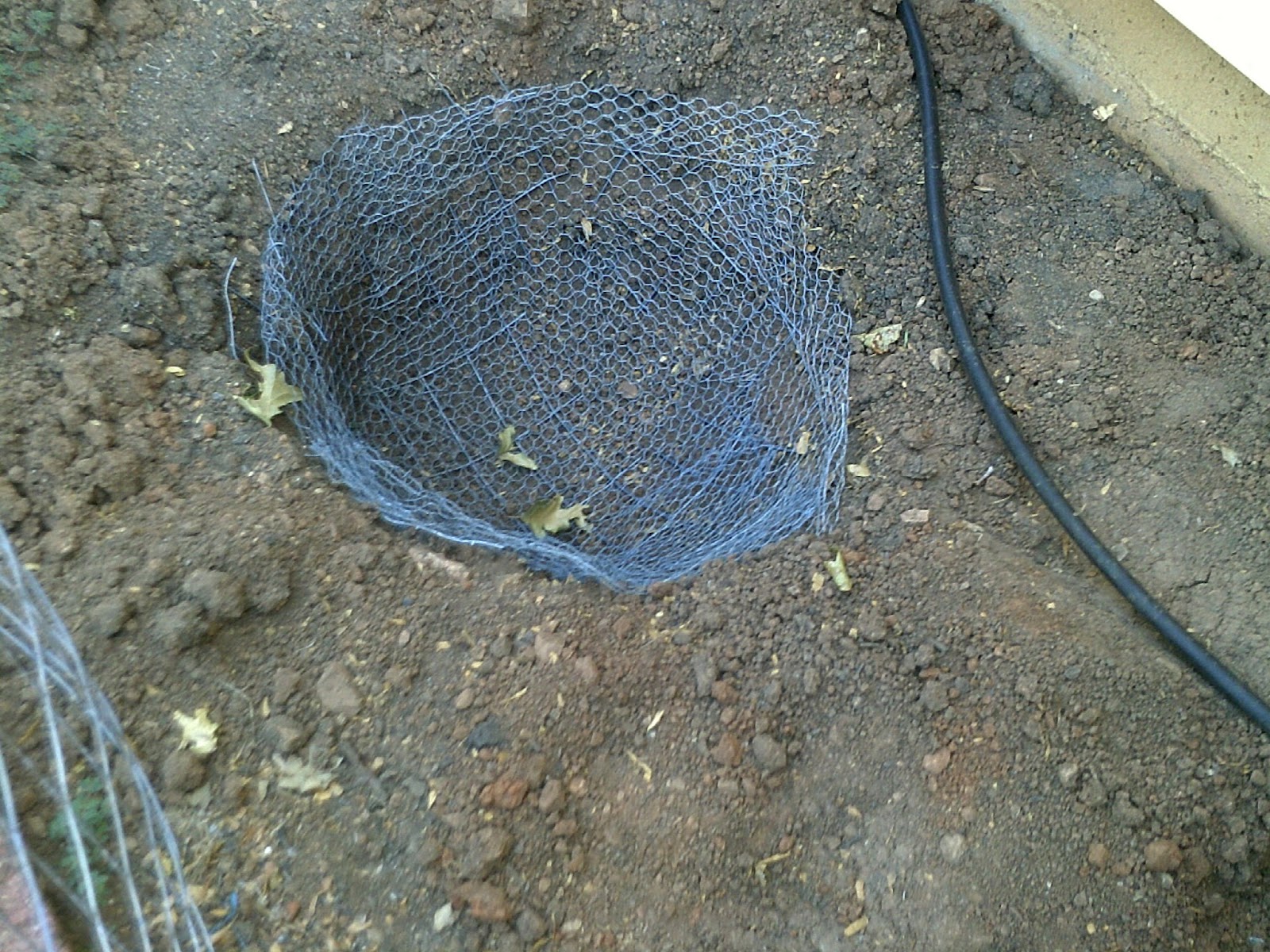
You can buy gopher cages ready made but you can also make them pretty easily for a lot less money.  I do have some thicker gauge wire underneath that standard chicken wire, a couple of layers of metal for those little bastards to try and gnaw through. 

To the right of the arbor, right in front of the picket fence, there have been two rose stubs for the past two years.  That's stubs, with a"T", not shrubs with an "H".  This year I decided to give them half a chance by putting up a little deer protection as you can see below.  We have been rewarded with some red climbers and quite possibly a Peace Rose, AARS Winner in 1946.  It's amazing what can happen to your plants when you stop the constant munching by that most predatory, foul, flea infested rodent, Bambi.


I think it's time for another tune.  God bless Jerry Garcia.

After you pass through the arbor, there is about a twenty foot long planter box on the left on the way to the front steps.  Then after the steps, there is another twenty foot planter box that sits right beneath our covered front porch.  These two areas were designated Rose Land from the get go, now it was merely time to get the roses in and protected.

I spray painted some simple T-Posts to dress them up and then posted them along the edge of the planter boxes.  Then I ran four foot fencing all along the front.  That has been more than enough to keep those rascally pests out, there's no way they'll jump into a narrow enclosed space.

Here's the first planter box on the way to the front steps:


And then the planter beneath the covered front porch:


The fence is a bit distracting, but completely necessary.   If that were not up there would be no roses.  Period.  I have also made a couple of gates that are very easy to remove and put back up to allow my lovely wife easy access to her roses.  Once the property perimeter fence and driveway gate are up, we will be able to remove the Rose Land fencing.  But in the meantime...

My lovely wife has done a tremendous amount of research on her most favorite of flowers.  There are books and then there are books.  Once again on EBay we found a fabulous tome on Roses, the American Rose Society's "Encyclopedia of Roses," a regular $40.00 book.  We paid $5.00, and $4.95 for shipping.   It even had its original cover!


Between that and the other 42 books on roses we already had and I'd almost say she's pernt near an expert.  Even if she never read a word some of the data would rub off on her just by osmosis. 

She decided to go primarily with Hybrid Tea Roses, which are a cross between hybrid perpetuals and an old fashioned tea rose.  They burst on the scene in 1867, and basically they grow a nice, robust flower on a long stem.  Her other requirement is that they all must be fragrant.

Here's her gang:
                                          Mr. Lincoln  AARS Winner 1965
                                          Paradise
                                          Francis Meilland AARS Winner 2013

                                          Girls Night Out
                                          Queen Mary II
                                          Oklahoma

And then on the other side, right now we only have one in the ground.  And she would be a
                                          Queen Elizabeth AARS Winner 1955

We currently have two other yellow roses in pots, Ch Ching and Gold Glow.


 We also have one other white one, Iceburg, that our daughter gave her mother for her birthday this year.

And we also have a tree rose, Julia Child, AARS Winner in 2006, with which I had to get somewhat creative with as far as deer protection goes.


You may notice a little ramshackle chicken wire underneath the bush.  I essentially made a chicken wire saucer about the size of an umbrella.  First I poked two-two foot long bamboo sticks through the bush.  Then I took some chicken wire and cut a circle to size, with a slit from side to center so that I could slip it in next to the trunk.  Then I used the ends of the sticks to hold up the saucer on the outside.  There's no way they can access the bush from the bottom, and there aren't very many eight foot deer that I've seen around here.  Julia's been out now for months and has not been molested by any deer.

Fels Naptha Soap

I first learned about Fels Naptha soap when I was a five year old kid running loose in the lovely and enchanting foothills of Saratoga, California, before all the silicon valley mega moguls started buying the land and building their blue chip mcmansions.

There was poison oak in them thar foothills, just like there is poison oak a plenty here in the Sierra Nevada Foothills.  It doesn't matter what foothill you might reside in, if you have poison oak in your neighborhood you want Fels Naptha soap in your laundry room.

I don't know what the magic ingredient is, but if you wash with Fels Naptha after you've been intimate with poison oak, chances are you won't get itchy.

I have been clearing the land here for almost three years now.  Intermixed with all the Manzanita has been a lot of poison oak.  A lot of it.  From your basic silly little bush to forty foot long vines with trunks over an inch thick.  Although I am generally prepared when I do the work, with long sleeves and work gloves, I know I have been violated.  My face has been brushed numerous times and it's tried to attack other bare skin spots when it can.

When I am done with the work, up to four hours later sometimes, I always shower with Fels Naptha.  I make sure all exposed areas of skin are lathered real good with the soap.  To date, I have only gotten one very small patch of poison oak on my wrist.  Probably on an occasion when I didn't expect it and hence, didn't lather.

If you have poison oak in your backyard, you want Fels Naptha in your laundry room.


Wednesday, July 31, 2013

Stairs, Steps, and Soliliquies

My lovely wife somehow finds the energy and wherewithal to get her gorgeous little keester out of bed at 5:00 AM three to four times a week to go to the gym.  Rain or moon.  Now that's dedication.

5:00 AM?   Who am I kidding?  I roll over and go back to sleep, for at least thirty minutes.    

She may have used a stair-stepper at one time, but now most of her cardio workout is done is on an elliptical machine.  I think that's the one that generally makes you look like an uncoordinated lunatic spazz, gyrating in some crazed form like you are on LSD and listening to a little soulful electro space age revelation euro pop punk.

Or maybe that was just me on the dang thing thirty years ago listening to Boy George.

Damn.  This is embarrassing.  I gotta stop sharing so many random thoughts.

I'll bet my lovely wife knows what she is doing on the elliptical machine.  She is the epitome of cool.  If it ain't cool, and if she can't do it cool, then she ain't gonna do it.  The Fonz ain't got nuttin on her.

Besides knowing what she is doing, even her workout attire is fashion cool.  And her outfit is always perfectly accentuated with short, sharp socks.  I love saying that.  Short, sharp, socks.  No doubt she is the best dressed morning athlete there, even her sweat sparkles and glitters with diamonds and  rainbows.  And tastes like honey.

What do I do for exercise?  Well, Goldie, the Rooster, rarely lets me sleep past 5:30AM.  So I get up,  trundle down stairs and make some coffee.  There's some leg and forearm action right there. 

As the coffee begins to drip, I grab any vegetable treats leftover from dinner and mosey on up to Chicken Fantasia Land.  There, I unleash the flock from their night time secure quarters and they gleefully scamper about scarfing up any and all treats I have strewn about.

That's about a fifty yard round trip, up and down hill, as quick a warm up as any for the rest of the day.

Then I assess and plan the day, once a little caffeine is coursing through my veins.  Each day usually requires multiple walks up and down and all around this homestead on the side of a hill.   Besides the stuff I do that I post, this year I've already got a cord and a half of fire wood bucked and stacked for this coming winter. 

Land clearing and firewood was covered one time in Where's Paul Bunyan and That Big Blue Ox, but they are both an ongoing and very LARGE chore.  At least for a couple more years.  I've also got another 2-4 cords down, almost completely bucked and the larger rounds ready for splitting.

Then stacking.  And then throughout winter, every week about three wheelbarrow loads of wood needs to be brought up and stacked on the covered porch.  And every winter day wood is brought inside to keep the house warm.   There's some constant action, forearms, legs, back.

And before the wood ever gets to that point, where it's burned as fuel, the downed trees and limbs have got to be brushed.  And then all the slash that creates needs to be burned.

And all that work happens on a hill.  Up and down, up and down, up and down and all around.  I'm getting tired just thinking about how many times I go up and down this hill.  

Who needs a gym?  I'm building a homestead on a hill.  And when I sweat, the sweat intermingles with all the dirt and dust that has landed upon my person from everywhere I've roamed.  Then it cakes upon my skin and I look like I have been laying on a beach in the tropics.  

It tastes like mud.

While it may seem to some of you that I have recently been a bit lackadaisical about posting to this blog,  rest assured, I have not been resting upon my year long laurels.  As a matter of fact, I need some rest.

I've got a couple hammocks out back in Hammock Land, but do I ever partake of their effortless ease?  Hell no.  I walk by many times per week, think about how good it would feel to simply sway in the breeze, and then carry on with my appointed chore.  They sure do look nice though, swaying there in the breeze.  A little Jimmy Buffett in the background...

I have been doing many things around the old homestead, and I do have quite a few upcoming post ideas now stacking up for your entertainment.  At least two.  What I haven't had was the time to sit here and scribe about all the silliness I do.

Since the first of the year, I have been working on another literary project that has taken up most of the absurd words that float in and out of my cranium on any given date.  That project has finally wrapped and is currently going through the edit process.  I hope to have that manuscript available in one format or another later this fall.  I'll keep you posted.

Two worlds will collide, even though nobody, not even me, has any idea who I really am.

Way back when I started Chicken Fantasia Land, essentially refurbishing an old goat pen the previous owner, Meathead Hoagie had built, I also had to address the ingress and egress issue.  I mean, I would have to visit this place at least a couple times a day.  While the location is perfect and relatively close, it's also on the up hill side of the equation.

The previous owner, Tweedle Doodle, had made zero attempts to access the goat pen save for compass, machete and a degree in gymnastics.  When I first completed Fantasia Land, with sweat and shovel I began the access issue.  I turned this inhospitable blockade of wood and dirt

into this, with no more than pick and shovel.  And sweat.  Besides widening the walk to 3 feet, I also initially took it down to the base of the retaining wall so that I could replace any rotted wood.  Then I tarred the dirt side of the wood and filled in the path at a comfortable grade, finishing with a several inch deep gravel top. 
The grade of this walk is nice and easy, but at the top, where you must make a hard left to get up to Fantasia Land, the grade gets steeper.

I initially made a cinder block landing, because at this point two walks behind the retaining wall converge and it was rather steep.


At this point I was debating whether or not to just add a hand rail all the way to the top or continue on up with some form of steps.  I had been contemplating cinder blocks, but those buggers cost over a dollar each now and I was going to need more than five.  My overall budget for the project was sweat, so I was going to be going way over budget real fast.

Then, as when a happenstance occurs, or as when circum stances, which is much different than circum cisions by the way, I happened to be visiting my son.  He was living with an old high school chum, and that chum had recently purchased his place on a short sale.  He had all sorts of projects going on, and one of those projects was to put decking all around the house.

The house is on some acreage waaay out in the country, almost in the middle of no where.  The previous owner, Buffalo Chip Brain, who lost the place in the real estate bust, had made up some pretty rip torn walk ways all over the place with some pretty nice rock.

The question begs where and how this inspired chowder head got all these really nice rocks and why he brought them to no where.  Maybe to make a really nice planter with mortar and pasties?  Nope.  Schnook Salad made walks.

Really fucking stupid walks.  The kind of walks that can kill you.  Seriously.  The walks were all uneven, sharp, jagged edges jutting up from the already uneven mosaic pattern like so many bozos on a bus.  Or like so many kernels of corn on a calibrated and syncopated kazoo.  They sat ready to add major insult to injury once someone had taken the inevitable toe stubbing tumble that was surely going to happen more than once.  Especially the way those boys drink out there.

As he was discussing his decking project, I began to notice the rock.  A lot of it was flat and had straight edges, and as I sized it all up I figured I could use it instead of cinder block.  I asked him what his plans for the rock were, and he said he was just going to cover it all up with the decking.  I asked if I could take some, like all of it, and he said help myself.  Total cost: sweat.

Three car trips later this is what I had.  By the way, most of those weigh more than a cinder block.

More sweat.

And then I got really sweaty and creative with a pick and a shovel.


Eventually I will plant some form of moss or ground cover around the rocks for added looks and stability.  I have left it all a little loose because I have to run a couple underground irrigation lines somewhere through the maze.  In the meantime, it's all solid enough for daily use and has already made the upward trek just a little bit easier.

I used the left over cinder block to the right as a retaining wall.  That little hillside meanders right on down to the door of the old pump house.  Even though the actual well below that house ran dry decades ago, there are still relevant valves I use as well as dry storage.  In other words, I need ingress and egress, hence the retaining wall.  I have planted some Phlox in the cinder block holes, which will bloom a bright pink come spring.  I call it my cinder block phlox.

You know, it's probably a good thing I don't rest so much.  Cause when I do, I usually see more things I have to get done.  Like, I was hanging out on the front lawn with the Grand Kids a few weeks back and I took a long look at our front steps.


I have had plans to redo the front steps, but at the rate these were going I was going to have to do it much sooner than I would have liked.  The planks are still solid, so I decided to do a little quick refurbishment.

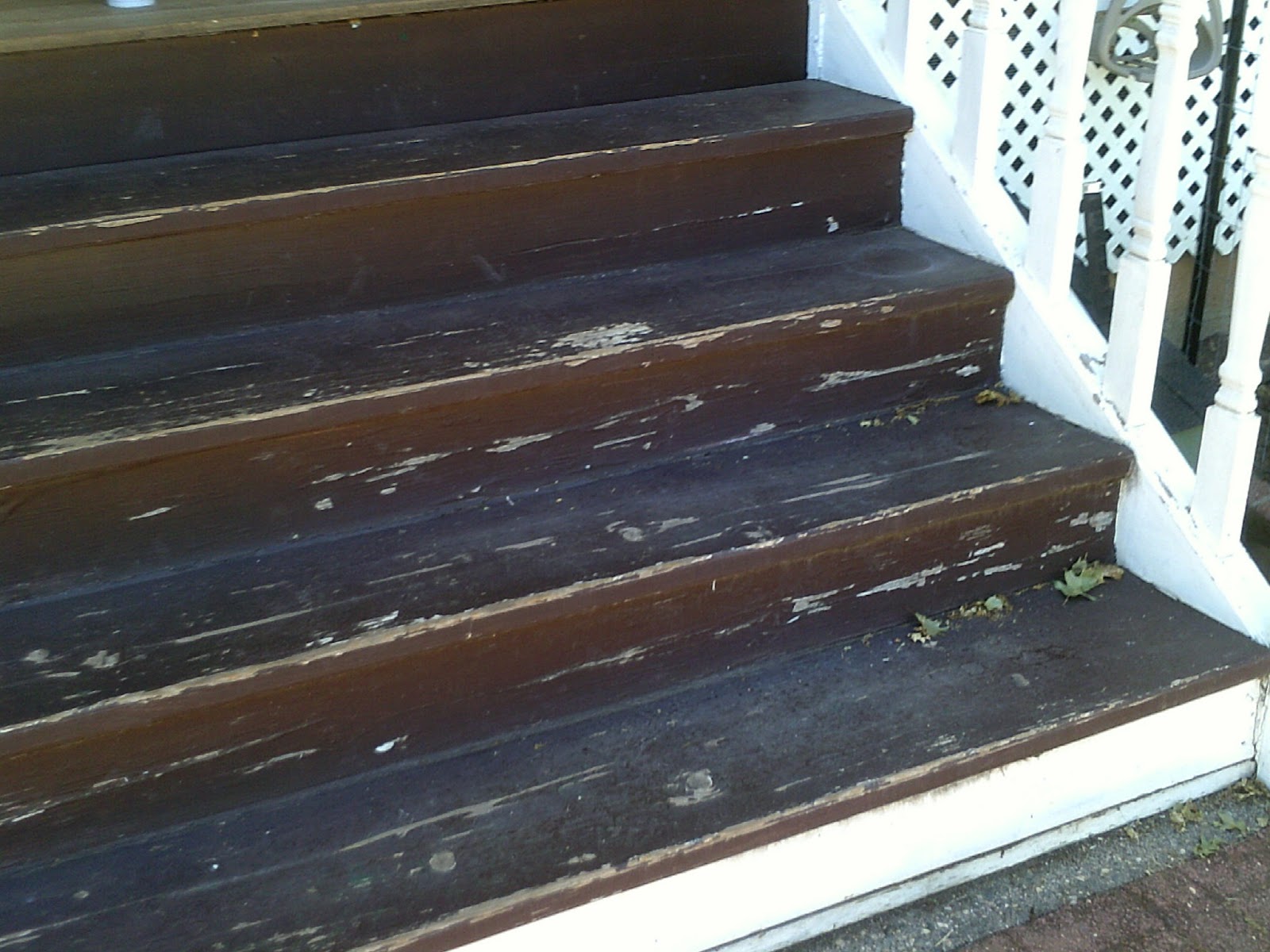
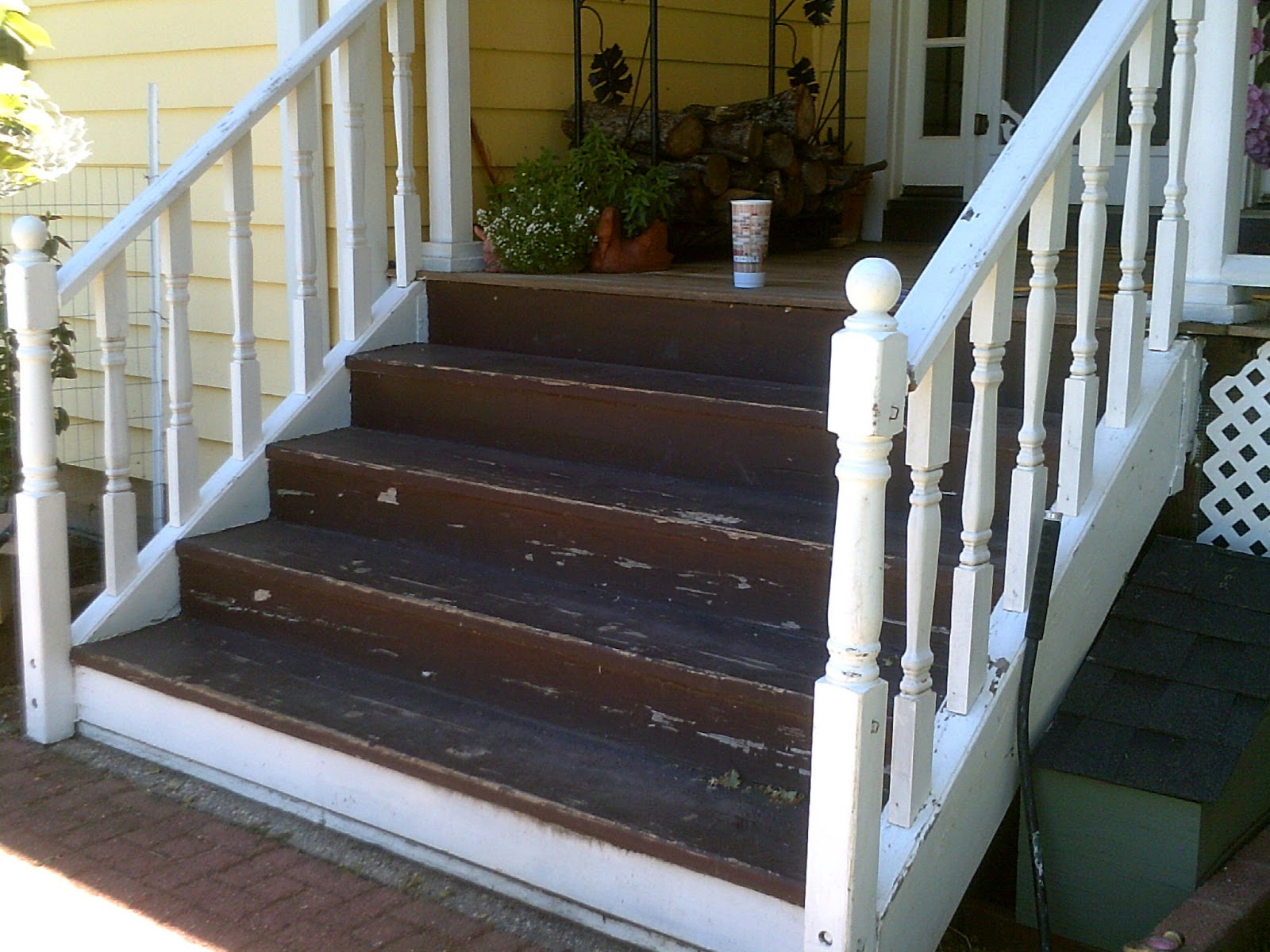
Besides the fact there were cracks, holes and crevasses, the existing brown paint was flaking.  Did you get that?  Existing BROWN paint?  Who in their right mind thinks that's a good color to mix with yellow and white?  How about Plow Head Jelly Brain, the previous owner? 

He must have been sniffing some good model airplane glue when he came up with that color scheme.  Besides the front deck steps, he also had all the window shutters painted brown as well.  And look at the stair newel posts...what was he thinking?


"Hmmh, need more glue.  Then I'll paint many things around here.  Brown.  Really bad brown.  Like Bobby.  Or Leroy.  I won't know why.   Has anybody seen my mucus membrane?"

The only lovely, ethereal, correctly color schemed apparitions in the above photo, taken when we were considering buying this place, would be my lovely wife and her lovely twin sister.

Sigh, twins.

Armed with blades, axes, hammers, pitchforks, sickles, scythes, sandpaper, a shovel and lots of caulk, I went to work.  I scraped, scaped, shaped, aped and then smoothed it all out.  It was one noisy-ass cloud of dust storm type of affair for a good two hours.  Then I hosed it off, let it dry and caulked the crevasses.

Next up was a delicate coat or three of semi-gloss white paint along the rail, and then some great Behr floor paint.  Black.  Add a couple carpet treads and it almost looks like new.


The shutters, by the way, turned black about a year ago.  It was such a small project it wasn't worth a post.
They were nailed in rather haphazardly by you know who, Puddin Puddle, the previous owner.  I almost needed a fork lift or two to get a couple of the nails out, but with enough force they succumbed to my effort.


Once down, they were all painted semi-gloss black, and then screwed back on.  That way when they inevitable exterior paint job occurs, they will pop off quite easily, without the need for a fork lift or spoon.

Speaking of small things and little victories, a Soliloquy is the act of talking to oneself.  Or it can be considered an utterance or discourse by a person who is talking to himself or herself.  Semantics.  The speakers are usually disregardful of or oblivious to any hearers.

I'm usually rhyming too, all day.


Chicken Update

Our little bare backed flock of eight, with their harem master Goldie, are all doing just fine.  There was another commotion the other night.  We sleep with all the windows open at night this time of year, taking advantage of that cooling Delta Breeze.  That also allows this very light sleeper to be awakened by all sorts of solos in the vast nocturnal symphony of sounds.

Around 1:00 AM I heard the snap of a twig, usually indicating the presence of a deer.  Another invading bastard.  You can read more about my views on deer here at Bambi Can Eat My Drawers.

Then as I lay awake, awaiting further sound, I noticed some of the chickens were talking.  It wasn't a happy type conversation, they never gossip or tell jokes after sunset.  It wasn't a dire squawk either.   

It was more like a concerned chatter, like, "We're not really frightened, but something is concerning us."

I got up and flipped on the flood lights, one of which hits the cage door dead on.  Once again I saw furtive movement, a quick shadow scampering out of the light.

It was .22 time.  I got the gun, a flashlight, scampered downstairs and headed outside.  As soon as I opened the back door I heard the varmint flee into the leafy night.  I sat there in silence for about ten minutes, but I heard no more.

I am now getting a profile and am pretty sure this is the same creature that took down all my Guinea Hens.  He's come around 1:00 AM all three times now.  The last two times I have had a shadowy glimpse, and from what I saw I'm pretty sure it's a raccoon.  I don't think it's big enough to be a Sasquatch or Nick Nolte.

The size is right for a Raccoon, and the varmint has got to be able to climb a wire fence.  It also has to have the capability to open up a fairly tight wedged gate, which is how Ginnie the Guinea met her fate.

A raccoon meets all these traits.

Fortunately, the flock gets locked up every night in their secure perch and hay filled indoor/outdoor suite, which actually could afford them more than enough room to live in luxury their entire lives.  They do, however, get let out every day to lift weights, smoke cigarettes and bathe by rolling around in the dirt.

In the summer, they get to frolic in Lake Capon, a three foot clay bottom puddle that stays full for hours.

What the hay. 


Wednesday, July 17, 2013

Spleen, Spline, Splenda, So What the Heck's the Difference?

The spleen is an organ located in the upper far left part of the abdomen, to the left of the stomach. Which sounds redundant to me, but maybe it isn't considering what I don't know about interior anatomy.  Which is probably different than interior decorating, unless you were considering painting your spleen.

Hmmh, what color I wonder?

The spleen varies in size and shape between people, but it’s commonly fist-shaped, purple, and about four inches long.  Because the spleen is protected by the rib cage, you can’t easily feel it unless it’s abnormally enlarged.  And that doesn't happen unless it's been punctured by something, which is usually a rib.  Then you can usually feel it.

A lot.

The spleen plays multiple supporting roles in the body.  It acts as a filter for blood as part of the immune system, old red blood cells are recycled there, and platelets and white blood cells are stored there. The spleen also helps fight certain kinds of bacteria that cause pneumonia and meningitis.   Which all sounds pretty splendid to me.

I would like to thank WebMD for that concise description of the spleen, without the additives of course.

Near as I can tell, it's kind of like the appendix.  You do better with it but still live without it.  Not like the liver.  Or brain, heart or big toes.  Can't live without those.

And the nasty bothers, if they do go south they need attention straight away.  Otherwise one turns ashen gray, or can't dance.   

Splenda on the other hand, is a zero calorie sweetener.  Splenda is a trade name for sucralose, a synthetic compound stumbled upon in 1976 by scientists in Britain seeking a new pesticide formulation.  Does that tell you anything?

It is true that the Splenda molecule is comprised of sucrose (sugar) — except that three of the hydroxyl groups in the molecule have been replaced by three chlorine atoms.

What does this mean?  I have no idea.  But it does mean this: No diet drinks for me!

It sounds to me like that little chemical additive will not only not add calories to your diet, but it should also keep most insects out of your intestines.  Or spleen for that matter.  And it sounds like you could use it in your swimming pool, you know, if you wanted to keep the water sweet and algae free at the same time.

For a spectacular write up on the subject, you can check out this site: womentowomen.com.

That brings us to the main subject of this post, spline.  So what the heck is spline?

Well, if you've ever replaced any screen in a window or door, spline is the round, thin rubbery whatzit that goes in the frame groove and helps straighten the screen as well as attach it to the frame.

Another one of my hundreds of burning projects around here has been screen replacement.  Most of the screens here probably haven't been replaced since they built the house.  Half the damn screens had holes big enough for a Tarantula to fly through.

As if that's what we need, large, flying spiders.  We already have a big enough problem with all those dang flying monkeys.

Fortunately Tarantulas have not yet adapted to flight, but moths the size of Canada have been able to come in and swallow a half dozen cashmere sweaters.  After the last sweater disappeared, I figured it was time to take on the screen project.

This old farmhouse was built in the late 1970's and sits facing almost directly West.  We get lovely sunsets now that I have cleared the view, but that view comes with a price.  On summer afternoons the sun has direct access to the entire front of the house.  It gets hot.

On the positive side, there is good tree coverage on the East and South sides, with the sun not even hitting the structure until late morning.  But after that, Sahara on.

We have two majestic oaks in front, and they do provide a fair amount of afternoon shade to the house, depending on the time of year.  Nevertheless, we made a few great improvements to minimize the sun's heat and impact on these hot summer afternoons.  I mean, a few weeks ago we had a 6-7 day triple digit heat wave.  Who on earth thought that was a good idea?

Speaking of heat, I spent too much time working outside one morning during that wave.  I ended up inside writing with an ice pack on the back of my neck and shoulder.  It helped immensely at cooling me down.  If you're ever stuck outside and have to deal with the heat, here's a great cooling tip I learned many moons ago in my volunteer firefighter days:

Wrap up some ice in a bandana, shirt or whatever and tie it around your neck with the ice on the back of the neck.  Cool that carotid.  You'll be amazed at the difference that can make.  If you're out on a fire line in the middle of no where and don't have convenient access to an ice machine, water works too.

Our second year here we added awnings on the two-second story west facing windows.  Now the sun does not have direct access to either window, and I think we've dropped the internal temperature of those rooms by at least 5 degrees.  Which is good, because I'm sitting behind the 2nd story window on the right most hot summer afternoons.  The awnings also add another aesthetic dimension to the front of the house, if you like aesthetics that is, which I believe I've already covered in my Garbage Depo post.  The two lower windows are the on the side of the garage, not necessary to awn.


Last summer we put up interior blinds in all the bedrooms.  Besides a little privacy, they add a nice sun and heat buffer as well.  And then for the final window treatment, screens.

Almost all the windows are double pane with wood frames that slide vertically.  This means I was able to cover all the glass with screen.  Only the sun room has horizontal sliders, but that's going to be a different screen application anyway.

In doing my screen research I discovered there is a solar screen which will block 70-80% of the sun's heat and glare.  It is a little pricier than regular screen, but since I had nine windows that receive blazing, obliterating, afternoon sun I wanted the benefit of everything I could throw on them.

Most of the existing screen frames were in good condition, but there were a couple arms and legs that needed a little straightening.  A couple others needed to be replaced entirely.


And, as you can see, there was paint and crap all over the original bronze colored frames.  The first step was to find a loose end of the existing spline and dig out the end with my trusty little ice pick.

I use my trusty little ice pick for a lot of things, but never for picking ice and never like Sharon Stone used hers in Basic Instinct. 

Once an end is free you can usually just pull it right on out.  Sometimes there are a couple sections of spline end to end, so I had to dig in there and get it started again.  After the spline is out, the screen comes away from the groove and frame quite easily.

Then it was time for frame repair.  I was actually able to straighten out a few of the bent frame legs, but a few of them were toast.  Fortunately, I bought a couple extra six foot sections of frame when I picked up the screen.

After measuring, I used a good, old fashioned miter box and hack saw to make my diagonal cuts.


Then it was off to the paint shop, which consisted of a canvas tarp on the driveway.


Then I joined the repaired arms with the little internal 90 degree thing a ma bob.  Thing.


Once the frames were painted and together, it was time to apply the screen and spline.  Two items that are essential when doing this project are these:


One is called an exacta knife, the other is called a: wood and steel screen roller, 2-wheel wood handle screen tool, screen spline roller, professional screening tool, spline roller tool, or, if you're me, a screen roller thingy.  

You must have this tool.  It ranges in price from $5 to $25.  I bought mine for $5.00.  I've replaced a lot of screens so far, and the tool looks like it'll handle a lot more.  I wouldn't spend $25 for this tool unless I was re-screening an entire city block of sky scrapers.

And, if you've ever tried to re-screen a frame with a screw driver and think you're bitchin, forget it.  For five bucks this holy roller will so simplify the process you'll easily forget why you ever thought you were bitchin for using a screw driver anyway.

So then I rolled out the screen and cut it with a couple extra inches to spare.


Once the screen was placed over the channel, it was spline time.  Speaking of which, when I first started the project I bought a bag of spline for $5, primarily to make sure I had the right size.  Yes, there are different sizes of spline just as there are different sizes of pants.  Live with it.  Just make sure you get the correct size before you start.

So anyway, the $5 bag of spline did about a frame and a half.  I found the roll below on line and paid about $20.  There's enough spline on this thing to do that entire city block, if only I had a better screen roller spline thingy. 


I started the new spline at one corner, initially getting it into the groove with my fingers.  Then I got into the groove with a little Tower of Power.  Next I deployed the roller thingy, rolling the spline into the groove, all the while holding some tension on the inside part of the screen so that the groove rolling thing wouldn't make the screen go catty wampus.  By holding tension on the inside, the screen that fed into the groove came from the outer edge. 

Once spline was all the way around, I re-rolled the entire frame, causing the screen in the middle to stretch and become taut.

After that, I cut the excess screen with the exacta blade, just running the tip along the inside edge of the frame. 


Then I did a little touch-up paint and wallah, new screens!  Besides the solar shading aspect of the screen, it has also added an unexpected aesthetic dimension to the color scheme.  There's that aesthetic word again, my middle name.


It is a little darker inside the rooms, but not extreme.  The remainder of the house gets regular screen, which I should finish by the end of the year.  Several other projects have now come front and center, as they always do.  But at least the screens with the most wear and tear have been replaced, with substantially better quality and efficiency.

Guinea Hen Update

And then there were none.  I snapped this shot of Ginnie the Guinea a couple weeks back, just to give you an idea of her prehistoric little albino head before it disappeared.


The night after I took the photo, around 1AM, she started making a commotion.  After the massacre, I am keenly aware of the sounds these birds make.  I was up immediately and switched on the perimeter flood lights.  A pesky deer that was near Chicken Fantasia Land bolted.  I thought I saw another furtive movement inside the chicken's fenced yard, so I got my .22 and went out for further investigation.

Quiet and stealthy, I heard not a sound as I approached.  I saw Ginnie in her companion cage, it appeared she was alive and well.  I didn't see or hear a varmint at all.  I went back to bed.

To my dismay, the door to Ginnie's cage was open the next morning and she was gone.  Poof.  The cage door was not latched, but because of it's wedged in nature it takes a little effort to get it open.  Well, something apparently did, and right next to a Nite Guard solar powered strobe, which is supposed to prevent this sort of attack.

Maybe it was Nick Nolte smoking that silver blue Krylon again.


Friday, June 28, 2013

The Companion Cage / Massacre at Keet Creek

As you may or may not remember, I made me buy 4 Guinea Hen Keets a few months back.  Keets are the chicks of the Guinea Hen world.  They were already good sized babies when the feed store seduced me into buying them, so their time spent in a cardboard "brooder" with light on in the garage was short.  I only had a few weeks to create a space for them to bloom into adulthood.

Fortunately, I have had a blooming plan for this for a while now.  I will also need a space to bloom new hens when I start adding to our flock.  The best way to introduce a new hen or hens to a flock is to let them live near and around your existing flock for a few weeks, but separated, preferably by wire.

I have the perfect area for this.  There is a little six foot space between the fence and the chicken cage that was the perfect fit.  All I had to do was wire the roof and one short wall.  All wired connections are tightly secured every couple inches with more wire.  It's heavy gauge wire and will easily accommodate a raccoon, weasel, small alligator or even Nick Nolte if he's hopped up on Silver-Blue Krylon again.


Then I slapped up a little short term make shift gate,


Tossed in a garbage can with hay for shelter,


And wallah, home sweet home.  The perch was already there, this area had been a little hideaway for the regular flock from the get go.


The companion cage is now right next door to where the main flock eats and sleeps and cock a doodle do's.  Whenever a new hen, now, or in the future, will need to be integrated into the main flock, this is where they will begin their life after the brooder.  This way everybody gets to smell each other and know each other for quite a while, or at least a few weeks before they get to potentially touch.

It worked well.  The keets were scooted out there in late April and grew quite handsomely.  To my dismay, their voices changed and their delightful little keet chirp banter turned into the clack and snarl of a punk rock band.  Every once in a while all four of them would engage in a frenzied cacophony of unearthly sounds, sort of like an encore at a Clash concert.

I also noticed that their bodies were becoming cloaked in a beautiful array of gray and white feathers.  Then there was a little bit of a lovely blue hue leading up the neck towards their absolutely freakish looking prehistoric heads.  Teradyctals don't have anything on a Guinea Hen.  Neither do Jabba the Hutt or Phyllis Diller.

I wanted the Guineas to be about the same size as the other hens in the flock before I integrated them.  The hens and Goldie, the Rooster, would stop by the companion cage from time to time to check the keets out.  Then, when the hens would come in to roost,  the keets would be drawn to the always cluck cluck cluck boisterous affair going on six inches from their little prehistoric heads.

It's especially boisterous now.  I have recently discovered a wonderful new trick for locking the flock up a little earlier than dusk, which always causes an extra rousing round of boisterousness.

As you may have noticed, dusk comes later and later this time of year.  Hell, the sun's going to be setting past my bed time soon.  And that's when it's a drag to lock up the flock.  When you're on a sleep walk.

 So I inadvertently started bribing them with some grain feed called "Scratch".  It's called "Scratch" because you toss it on the ground and the chickens will scratch around and pluck it up.  Chickens also need to inhale some dirt and grits, as well actual nourishing food.  Since they have no teeth, their food gets down in their gut somewhat whole.  Having some little rocks rolling around breaks up the food and helps them digest.  When they're in the brooder, I add some grits to their feed, just like a good southern host should.

The flock is generally very self regulating.  Even when they were allowed to roam, as soon as the sun starts to set they enter their secure area and perch up.  I started tossing in a little grain to give them a bed time snack and soon discovered that treat will lure them in just about any old time.

Their Hilton accommodations already include an unlimited amount of champagne and caviar.  They also have access to several indoor perches, as well as a total of five indoor nesting boxes.  There's hay everywhere.  They also enjoy another three or four perches outside, but within bullet-proof security.

This is where most of them can be found at night, perched up in their cage, even when its twenty-eight degrees outside.  One or two have actually spent the freezing nights in the warmth and shelter of their house, but the majority sleep outside.  The total secure area for them would be like living in an entire thirty-fourth floor suite at the Peppermill in Reno, or hanging out in the Candleabra Ballroom at the Radisson in El Centro.  Depending on your point of view.

I think there was a point to all this.  Oh yes, the bed time bribery snack.  They love it and scoot right in, rabbling and rousing and enjoining in a rousing chorous of cluck cluck cluck.  I think the keets really wanted to be a part of that action.

It would be like if you were a teenager, and you lived next door to a bunch of folks that drank beer and ate food and smoked pot all the time.  And they were laughing and singing and having a blast every night.

Or maybe it was like a really rollicking quilting party, or Parcheesi party, or any other kind of outlandish social occasion that would look enticing.  Whatever your proclivity.  And it all looked so very fun and you really wanted to be a part of that action, but you were fenced out.  You were a Guinea non Grata.  That's how the keets felt.

When the keets were close to hen size, and on a whim, I opened their gate on the 4th of June.  They were hesitant at first, but soon enough one and then two ventured out.  And then they were all out.  And it was such a non-issue it was amazing.  It was as if the hens and Goldie didn't even know they existed.  The four of them pretty much hung around together, but they would all intermingle with the main flock as if they had been there all along.

I was mostly concerned about how our Rooster would react, and he hasn't even blinked.  He hasn't gone looking for anything strange either, if you know what I mean.

As you may or may not know, the Guinea Hen's pest control prowess is legendary.  That's why I wanted them.  Besides bugs, they do snakes and rodents.  I was also piping in subliminal messages to their garbage can nest at night to get them palpably excited about the prospect of terrorizing deer.

Guineas are considered wild, not domestic fowl.  They will alert a flock of chickens to potential danger.  They are purportedly great watch dogs, and will let you know when danger or even an intruder happens along.  I heard that you don't have to lock them up at night, that they are adept enough to take care of them selves.

On the other hand, a chicken's metabolism slows when the sun goes down.  They are essentially defenseless against any potential night time danger, like Ozzie on cough syrup or Nick on Rustoleum.  That's why I lock them up every night.

I left the keets alone their first night.  Besides their adolescent stomping grounds and garbage can shelter, they had free run of the entire enclosed area.  This included a couple more perches.  Fowl are funny, instead of scootching down in a nice, secure box of soft hay, they choose to grip a piece of wood with their talons and stand all night.

That first night, the keets all spent a lovely night on one of the outside perches.  Then about midnight on the second night, the 6th, they created a cacophony that sounded like Patti Smith was Flogging Molly with the Dead Kennedy's Sex Pistol.

I'd heard it before, many times, just not at midnight.  The time was not registering in my cranium.  Through the shrouds of fog, mist and dancing bears running around my sleepy head, I told them to shut up.  It was too late to be partying and time to go to bed.  

The next morning, around 6:00 AM, the chickens were making a lot of extraordinary noise.  That's something they don't usually do.  Our rooster will usually start crowing about 5:30 AM, but he had been extraordinarily quiet.  And the tone of their clucking was different.  Something was up. 

I went out, and, much to my dismay, there was a headless keet outside the fence.  Then there was half a  carcass of another wedged between the fence and dirt, but inside the fenced area.  One keet was missing entirely, the trail of feathers leading off our property before any slaughter was seen.  And then there was one traumatized keet hiding in the garbage can.  The chickens and Goldie were all fine.

It looked like the tattered remnants of the Alamo, or the decimation at Custer's last stand.  Or leftovers of Nolte's after he's been out on a Krylon binge.

I removed and buried the dead birds and then opened the flock's cage door.  It took them about an hour before they finally ventured out, with Goldie, the Rooster, leading the way.

From the reading I've done, I'm pretty sure it was probably one or two raccoons.  A fox or any kind of cat would be selective.  They'd grab a bird, take it away and then dine.  Then come back the next night. When a fox or cat is the intruder, there's not a Valentine's Day massacre scene to contend with, you generally just start losing birds.  

Racoons, on the other hand, love to come in and create a major ruckus.  It's like they drank a couple of Olde English 800 40's and swallowed a handful of PCP tabs and then went out to party.  I guess the only thing left to ingest was a quart of Guinea Hen blood.  Off with their heads!

For those of you unfamiliar with OE8, it harkens me back to days of yore.  A hearty malt liquor, it tasted disgusting.  But you could catch a buzz off one tall boy, and a six pack of tall OE8s cost under two bucks.  It was a very economical way for a car load of high school boys to catch a buzz on the way to a football game.

One of the racoons major tells is their methode de decapitation, and they have no compunction about obliterating an entire flock just for fun.  And then run, laughing all the way.  They have just become number two on my most hated wildlife list, with deer remaining numero uno.

I also have to take some heat for the massacre.  While they most certainly can be wild fowl and able to take care of themselves, these guys were still rather adolescent.  I probably should have locked them up at night as well, for at least another month.  Or at least until they showed a good ability to fly, which is their major route of escape when they feel threatened.

We now have one very lonely, forlorn and traumatized adolescent keet.  Poor thing.  I barred her from her original hang out, the companion cage, with the hopes she will socialize with the other hens.  She found a perch inside the hen house, and except for food and water, she didn't leave the safety of that place for about a week. She pretty much just hung out on a perch inside the house, facing the corner while visions of Freddy Krueger and Godzilla filled her head.

She finally ventured out about a week later, and is probably doing the best she can.  My lovely wife has named her Ginnie, Ginnie the Guinea.  Some nights she will sleep in the cage with the rest of the flock, sometimes she's in her own companion cage, which is also secure.  Either way, she gets locked up at night just like her cousins. 

I'm not sure if I will get more Guinea Hens, there is a noise factor I had not considered.  Most of our neighbors find the crow of our rooster charming, however, if they had to listen to The Clash at top volume at all hours of the day and night they might not stay so enamored.

Based on the following, and even though we don't let the flock out of their fantasia land anymore for their own protection, they are still cage free, free range and organic.

Omelet anyone?

Cage-free

Chickens are often kept in row after row of compact, wire cages. This practice allows a maximum amount of egg-laying chickens to be kept in any given space. Unfortunately, the chickens have no exercise and little freedom of movement, meaning that they are often malnourished and in the poorest of health, with the quality of the eggs they produce likely to suffer as a result. Eggs from chickens kept in cages will be the least expensive on the market. Hens in a cage-free environment have, at the very least, freedom of movement around a barn or some other form of hen house.

Free range

Eggs from free range chickens are slightly more expensive than other varieties, but these eggs are from chickens that have access to a farmyard or other sizable outdoor enclosure. These chickens are able to obtain exercise by wandering around freely and will have likely access to fresh grass, insects and grubs. This means the quality of the eggs is improved as a result.

Organic

Chickens are often fed artificial growth stimulators and other synthetic foodstuffs as a means of bringing them to killing size quicker, or otherwise making them more financially viable to farmers. An organic label means that the eggs have been laid by chickens that are fed only naturally produced foodstuffs and have not been fed or injected with any chemical substances. Where eggs are deemed to be both free range and organic, they will likely represent the upper range of the price scale.

Friday, June 7, 2013

Tom Kitten's Last Walk to Forever

Sometime the afternoon of May 28th we thought our top cat, Tom, the one eyed Bandito, on or about his nineteenth birthday, took his last walk to forever.  Over the last year or so, his health had diminished and he had become rather frail, weighing in at six pounds, about half his prime, top cat fighting weight. 

He lived a storied life, full of wonder, activity and love.  The bond between that cat and my lovely wife was something to behold.  Even when he was the top stud cat of the neighborhood, a keen, agile adversary to any cat that wanted to prowl around his territory, Tom would curl up with her at night and purr like a kitten, well into his adult life.

In the last couple of years, he would always be found next to her head at night, softly purring as they both drifted off to sleep.

He was the smartest cat I have even known.  This last winter we passed in the foyer, and, since I was on my way to the sofa for a little lap top time, I asked him if he wanted to meet me there.

"You want to sit on the sofa with me for a while Tom?" I asked, the cat.

He promptly meandered over to the sofa, hopped up and waited for me there.  How smart is that?  For a cat?

We knew his days were numbered.  Since he put up his gloves after his last skirmish well over a year ago, his pace has slowed dramatically.  He sustained a couple injuries at that time as well, so he and I had a conversation.

I told him it was time to put up the gloves, he was, after all, seventeen years old.  That would be somewhere in his late eighties if he was human.  This was calculated by the following formula, more or less:

  • 1-month-old kitten = 6-month-old human baby
  • 3-month-old kitten = 4-year-old child
  • 6-month-old kitten = 10 human years old
  • 8-month-old kitten = 15-year-old human
  • A 1-year-old cat has reached adulthood, the equivalent of 18 human years
  • 2 human years = 24 cat years
  • 4 human years = 35 cat years
  • 6 human years = 42 cat years
  • 8 human years = 50 cat years
  • 10 human years = 60 cat years
  • 12 human years = 70 cat years
  • 14 human years = 80 cat years
  • 16 human years = 84 cat years
Or you can peg the first two human years of a cat's life at 25 and then each additional human year would be 4 cat years, more or less.

I also told him that if he did get in trouble I would back his play.  Fortunately, Tom put on his gentleman's top hat and mellowed substantially.  He had a favorite chair to sit on the front porch, as well as a favorite in the back.  Most days he could be found in either one, when he was not taking leisurely strolls around the property.

If he hadn't mellowed out, I could have seen myself in all sorts of deep doo doo.  Tom's not backed down from a wild fox nor anything else I suspect.  I could have easily seen myself going round and round with a grizzley bear if Tom hadn't slowed himself down.  That, and, of course, if grizzleys inhabited these woods.

My lovely wife took him to the vet only a month or so ago.  For a nineteen year old cat he was doing great the vet said.  But he was getting old and frail.  And moving ever so much slower every day.

I saw him the morning of the 28th down by the road, and then when I got back from the store he was up at the house.  But the last time I saw him was before noon, and he stopped going on lengthy roustabouts long ago.  His rat pack carousing and hunting days were far behind.

We discovered him missing that night.  He wasn't at either porch, and did not come when called or whistled for.  Yes, Tom responded to a little whistle my wife made up for him.  Nothing.  My wife even got in her car and cruised back and forth on the road for a while at dusk, calling for him and whistling.  Nothing.

Wednesday morning I did a perimeter walk of our property, calling for him, and looking under bushes and trees.  Nothing.  All this while my wife and I were figuring he might have taken his last walk, as cats are want to do.  We've had cats all our lives, and those that have lived to a ripe old age eventually wander out into the sunset, never to be seen again.

My lovely wife and I were grief stricken most of the day on Wednesday, the 29th.  Besides the fact I was
missing the beast, I was also distraught because I had not had a chance to say a final goodbye.  We'd been talking, of course, and expecting it, but you never think it's going to happen this day.

Our son came over for dinner the evening of the 29th.  We had a nice visit, and he left as dusk was approaching.  My wife and I were in the front yard, admiring some newly planted roses, and then I heard our son coming back up the drive.

As he pulled up he rolled his window down and asked if we were missing a cat.  He had Tom!  He saw Tom in his rear view mirror staggering across the road just as he was leaving.

My wife was ecstatic, as was I.  Tom was war torn, weary and somewhat delirious, but he was back in our arms.  We immediately got him some water, and over the next couple days he drank and peed.

Since he found one of his favorite places to sleep, under a dresser in our bedroom, we set up camp for him upstairs.  Always fastidious, Tom always used the Booda Dome cat box we have in our utility room.  That was fine, but it was also down stairs.  It was a heck of a haul for a ninety something year old dehydrated cat.  So we set up a little cat box in the master bath and also had cold water dripping out of the bath tub faucet for him.

Not content with drinking water out of a regular water bowl, Tom was always prone to drinking toilet water.  Eau de toilette!  But in his weakened condition, he cold not navigate jumping up on the bowl and leaning in for a sip.  We were also afraid he might slip in and drown himself.  He was good with the bath tub drip, and would actually lay in the splatter as he lapped the water.

Over the next two days Tom semi slept under the dresser.  His one eye many times would remain open, and many times he was far, far away.  The first day he had no purr, and then it returned on Friday. 

On Saturday, June 1st, we took him to our vet.  Harboring no illusions that this might be Tom's time, we still wanted our Vet's valuable input.  Since Tom had been drinking and peeing a lot, it was quite probable he was going into renal, or kidney failure.  I mean, if you're in your nineties, sooner or later something in your body has to start failing.  But, it could also be a symptom of dehydration.

We decided to have Tom hydrated, which was done by having an IV inserted underneath his skin and then having some vitamin water drip in between his fur, skin and tissue.  He also got a shot of some B vitamins.  If he was only dehydrated and not going into renal failure and dying, this would give him a boost and maybe then he'd have another few months of living to do.  Tom also swallowed a few bites of food at the Vet's office as well.

Unfortunately, there was more to Tom's situation than just simple dehydration.  His condition did not improve at all through Sunday.  Monday morning, still very dilapidated, he wanted to go outside.  That was something we had resisted because he was so weak, but by that time he was only able to go a few feet before having to stop and rest.

I took him out to his beloved outdoors, and laid him down on the cool, sweet lawn.  About this time a Neil Young tune was echoing through my chorus.  Tom rubbed his nose on the grass, and lay there, breathing softly as the morning birds offered a beautiful serenade.   Tom spent most of the day out on the lawn, soaking in the sounds and smells of nature as his spirit drifted on.  A little Joe Walsh was playing on his Cat Pod. 

He was still breathing when my lovely wife came home late in the afternoon, we were both amazed he was still alive.  He was, without a doubt, the cat of steel.  His one eye was pretty vacant, but he was still alive.  He'd been in that same condition since mid-morning.  Since Tom was really my wife's cat, she made the call.  The vet could see us at 6:45 that evening, the evening of June third.

We drove in silence to the vets, tears falling from both our eyes.  The Vet, Richard Heisey, 530-271-0101, was kind and gentle.  Especially with us.  We love our vet!

My lovely wife held the almost comatose Tom, wrapped in a big blue towel, as the vet ever so softly injected him with sweet relief.  He was gone in seconds, no doubt listening to some Marshall Tucker on his Cat Pod as he left this dimension.

When we got home we ambled up the hill to Tom's final resting place.  I had dug the grave earlier in the morning, when it was still cool outside.   We scattered home grown rose petals and other flowers at the bottom, and then I laid Tom Kitten down.  A red rose was laid upon his body, and after I had covered him with dirt my lovely wife laid a red rose upon his grave.

What a miracle!  Tom Cat must have heard us calling, and somehow made his way back towards the house.  We may have interrupted his last walk, but maybe the love he carried for us was stronger than his last walk cat instinct.  He had to come back to say good-bye.

There were definitely some lucid moments on his part, and some definite purring as we talked.  He also, in his very weakened physical condition, managed to get up and sleep by my lovely wife's head for a couple last times.

We've had quite a few cats between us, my lovely wife and I.  There has never been one as smart or as brave as our Tom Cat.  Most cats would flee a running Hoover vacuum, Tom would play tag with it.  He was a part of our lives for eighteen years.  He saw both our children graduate high school and college.

What an opportunity, a chance to say good-bye and tell him how much we loved him, how much we cared, and how special he was.  He was intrepid, he was affectionate.  He brought a tremendous amount of love and joy into our house.  We will miss him dearly.

Now it is finally time for his younger brother, Joe, to be the King.  Poor Joe has lived all his seventeen year life under Tom's shadow.  Even though Joe was bigger, Tom's alpha dominance was established long ago.

It is now the time of King Joe's reign.

May Tom Kitten's spirit soar free, his memory will shine forever.